


Contents
- Why Korean cosmetics are effective: what is behind the results
- Scientific evidence and the limitations of efficacy claims
- Key ingredients in Korean cosmetics and what they do
- Korean facial routine: minimal care without unnecessary steps
- Korean cosmetics for sensitive skin: safety and patch testing
- How long it takes for Korean cosmetics to work and how to evaluate the results
- Conclusion
- Frequently Asked Questions
Last updated: October 4, 2026
Why Korean cosmetics are effective: what is behind the results
Korean cosmetics are effective because they prioritize prevention and skin barrier health over hiding imperfections. Instead of harsh formulas that clear up problems at the cost of irritation, the K-beauty routine works on the principle of multi-layer hydration and gentle care applied consistently over time. This is also why more and more women are researching why Korean cosmetics are effective before changing their products.
In this guide from Bellaskin, we examine what really lies behind the results: which ingredients work, what are the limitations of efficacy claims, how to build a minimal routine, and how to tell if a product is working for your skin type. We will pay special attention to safety for sensitive skin and the realistic timeframes for visible results.
Scientific evidence and the limitations of efficacy claims
The scientific basis of K-beauty is more modest than marketing implies. Certain active ingredients have solid research support, but a large part of popular claims regarding "porcelain skin" are based on small studies or laboratory results that do not automatically translate to real skin. Korean cosmetics are effective where the ingredient, concentration, and formula are tailored to the specific concern, rather than when the promise is universal.
It is useful to distinguish between three levels of evidence:
- Strong support: niacinamide for brightening pigmentation and regulating sebum; hyaluronic acid and ceramides for retaining water in the barrier.
- Moderate support: centella asiatica and green tea as soothing botanical extracts; fermentation for better formula tolerance.
- Weak or unconfirmed support: promises of the instant disappearance of scars or "cellular rejuvenation" without concrete data.
What is behind proven effects: mechanisms, not promises
To assess whether a claim is realistic, it is helpful to know how the ingredient works. Niacinamide reduces the transfer of melanin to epidermal cells, which explains why brightening pigmentation takes weeks, not days. Hyaluronic acid attracts and retains water in the intercellular space, but it does not "fill" lines; it improves hydration, not the structure of the dermis. Ceramides restore the lipid layer between cells, which reduces water loss and makes the barrier more resistant to external irritants. Centella asiatica contains asiaticoside, which has an anti-inflammatory effect and explains why it is used for redness and irritation.
These mechanisms also determine realistic expectations:
- Hydration and a feeling of comfort: improvement within 3-7 days because it relates to the water balance of the skin's surface layer.
- Sebum and pore regulation: visible change after 4-8 weeks of regular use of niacinamide in an appropriate concentration.
- Pigmentation and acne scars: 8-12 weeks or more because they depend on cell renewal and daily UV protection.
Limitations of claims and how to interpret them
The European regulatory framework for cosmetic products requires that claims of effectiveness be proven and understandable to the consumer, rather than misleading, as described in Regulation (EC) No 655/2004 regarding cosmetic product claims. Therefore, when you see "clinically proven," it is worth checking whether a method, number of participants, and duration of the study are mentioned. The absence of such information does not automatically mean that the product does not work, but it does mean that the claim cannot be independently verified.
Common limitations worth knowing:
- In vitro laboratory results do not reflect the action on living skin because they do not account for penetration, metabolism, and individual reaction.
- Small studies with 20-30 participants provide guidance but are insufficient for universal conclusions.
- Subjective assessments such as "more radiant skin" depend on lighting, photos, and the participants' expectations.
- Combined formulas make it difficult to determine which ingredient is producing the result.
How to verify if a claim is realistic
A practical approach to evaluating claims:
- Look for specifics: ingredient name, concentration, number of participants, duration.
- Check if the claim matches the mechanism: if the ingredient acts on melanin, the result cannot be instantaneous.
- Compare with generally accepted timelines: hydration, days; sebum and pores, weeks; pigmentation, months.
- Check if the product is suitable for your skin type: the same ingredient can be effective for oily skin and irritating for dry skin.
This approach does not require a laboratory; it requires attention to the label and your own experience. Korean cosmetics are effective when expectations are aligned with the real mechanisms of the ingredients, not the promises of advertising.
Key ingredients in Korean cosmetics and what they do
Ingredients in Korean cosmetics are selected by function, not fashion. Niacinamide reduces dark spots and supports the barrier, allantoin soothes redness, hyaluronic acid attracts moisture to different layers of the skin, and ceramides restore the lipid layer. Centella asiatica and snail mucin are used for their soothing properties, and botanical extracts like green tea provide antioxidant protection.
Active ingredients, concentrations, and compatibility
Concentration determines whether an ingredient is effective or just present on the label. Niacinamide in the 4-5% range is well-tolerated by most skin types, whereas higher percentages often lead to burning and redness in sensitive skin. Compatibility also matters: retinol and strong acids stress the barrier if applied simultaneously, so it is more reasonable to alternate them in the evening rather than combining them.
A practical rule for combining:
| Active ingredient | Combines well with | What to avoid |
|---|---|---|
| Niacinamide | Hyaluronic acid, ceramides | Strong AHA/BHA in the same step |
| Vitamin C | Sunscreen, Vitamin E | Retinol in the evening |
| Retinol | Ceramides, panthenol | Acids, Vitamin C |
| AHA/BHA | Soothing essences | Retinol in the same evening |
Korean facial routine: minimal care without unnecessary steps
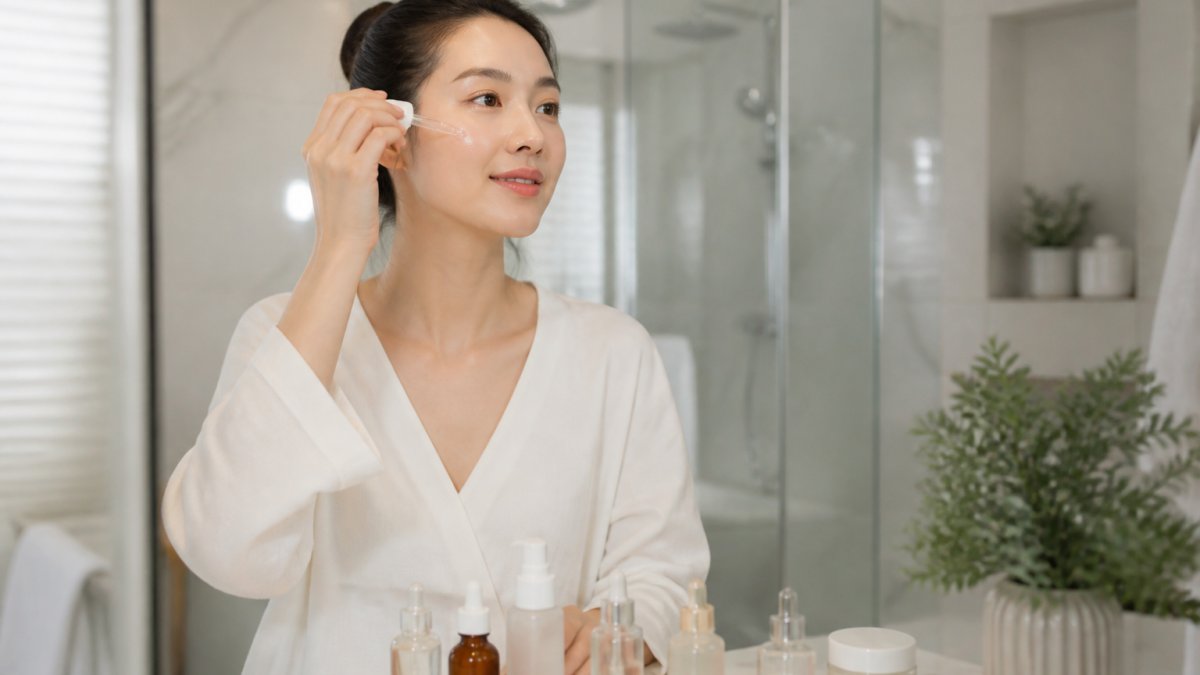
The foundation is double cleansing: an oil formula dissolves sunscreen and sebum, and a gentle gel removes residues without stripping the skin. This is followed by multi-layer hydration, where we apply a thin layer of essence twice instead of one thick layer of cream. The morning routine must always end with sunscreen, regardless of the season.
Peel Shot White Rice Peeling Ampoule →
Korean cosmetics for sensitive skin: safety and patch testing
Korean cosmetics for sensitive skin require more careful selection, not less care. Look for formulas without alcohol or strong perfumes, with soothing ingredients like allantoin, panthenol, and centella asiatica. Before applying a new product to your entire face, perform a patch test: apply a small amount behind the ear or on the inside of the forearm and wait 24 to 48 hours.
If you have ingrown hairs, blackheads, and dark spots at the same time, one product rarely solves everything. A more realistic approach is a combination: a gentle exfoliating product two-three times a week, a soothing serum every day, and sunscreen in the morning. If redness increases or burning occurs, stop the active ingredient and return to a base cream until the barrier calms down.
How long it takes for Korean cosmetics to work and how to evaluate the results
The realistic timeframe for visible results depends on what concern we are solving and with what active ingredient. Hydration and a radiant look improve within days because they relate to the water balance of the skin's surface layer. Blackheads and pore congestion require regular exfoliation and usually show visible change after several weeks. Pigmentation and acne scars are the slowest to improve because they depend on cell renewal and protection from UV radiation.
Timelines based on specific skin concerns and active ingredients
| Skin concern | Active ingredient | Realistic timeframe | What to monitor |
|---|---|---|---|
| Dryness and tightness | Hyaluronic acid, ceramides, panthenol | 3-7 days | Feeling of comfort, less flaking |
| Redness and sensitivity | Centella Asiatica, allantoin, green tea | 1-3 weeks | Reduced redness, less stinging |
| Blackheads and clogged pores | Niacinamide, low concentration AHA/BHA | 4-8 weeks | Less visible pores, smoother texture |
| Pigmentation and dark spots | Niacinamide, Vitamin C, sun protection | 8-12 weeks | Even out skin tone, lighten dark spots |
| Acne scars | Niacinamide, retinol (if tolerated) | 12+ weeks | Reduced depth, more even surface |
| Signs of aging | Retinol, ceramides, antioxidants | 8-12 weeks | Smoother texture, fewer fine lines |
These timeframes are approximate and depend on individual reaction, ingredient concentration, and consistency. It is important to note that results for pigmentation and scars are the slowest and require daily sun protection; without it, even a proven ingredient will not yield lasting results.
How to objectively evaluate if products are working
To objectively evaluate if your products are working, follow this simple method:
- Take photos of your face in identical lighting at the beginning and every two weeks.
- Keep a record of which products you use and in what order.
- Change only one product at a time so you know what is delivering results.
- Monitor not just imperfections, but also feelings of tightness, stinging, and redness.
- Give a formula at least eight weeks before giving up on it.
When to discontinue use
There are clear signs that a product is not suitable for your skin:
- Redness that intensifies after each use rather than subsiding.
- Stinging or itching within minutes of application.
- Dryness and flaking that occur after introducing a new active ingredient.
- New imperfections in areas where there were none before.
If these signs appear, it is wise to stop the active ingredient and return to a basic cream until the barrier calms down. Afterwards, you can try again with a lower concentration or less frequent application.
Minimal routine and the risk of too many steps
Effectiveness does not require ten products. A minimal four-step routine—cleansing, hydrating essence or serum, cream, and sun protection—covers the basic needs of most skin types. Each additional step only makes sense if it addresses a specific problem. Too many active ingredients at once overload the barrier and can lead to irritation, which slows down results instead of accelerating them.
If your skin is sensitive, start with three products and add one new one every two weeks. This way, you will know what works and what irritates. Consistency with few products yields better results than chaotically rotating many active ingredients.
Conclusion
The hardest part of K-beauty is not choosing a product, but having the patience to give your skin a consistent, gentle routine long enough to show results. If you are looking for a formula that combines efficacy with gentleness to the barrier, check out the American Academy of Dermatology's recommendations for acne and pigmentation care and build your routine around proven ingredients, not promises.
When skin is both sensitive and prone to imperfections, finding the right balance is the real challenge. Bellaskin offers a Korean formula with calendula and astragalus extracts, containing niacinamide and allantoin to soothe the skin and provide antioxidant protection. Our products help remove ingrown hairs, lighten dark spots, and unclog pores without overloading the barrier. Shop now and give your skin care that works consistently, not aggressively.

Frequently Asked Questions
Why is Korean cosmetics so effective?
Korean cosmetics are effective because they combine carefully selected active ingredients with gentle formulas and a consistent routine. The products often contain niacinamide, hyaluronic acid, ceramides, and plant extracts that support the skin barrier and hydration. The key lies in regular care and the fact that the formulas are designed to work mildly without irritating the skin. This allows users to see gradual but lasting improvements in texture and tone.
Which ingredients in Korean cosmetics are most beneficial for the skin?
Among the most beneficial ingredients are niacinamide for lightening spots and regulating sebum, hyaluronic acid for multi-layer hydration, ceramides for reinforcing the skin barrier, and centella asiatica for soothing redness. Snail mucin and green tea are also commonly found due to their antioxidant properties. Combining these ingredients in one routine can address hydration, restoration, and protection simultaneously.
Are Korean cosmetics suitable for sensitive skin?
Yes, many Korean products are formulated with gentle ingredients like allantoin and plant extracts that soothe the skin. However, sensitive skin requires caution: introduce new products one by one and perform a patch test on a small area before applying them to your entire face. Avoid using multiple active ingredients simultaneously and monitor how your skin reacts in the first few days.
How long does it take to see results from Korean cosmetics?
Initial results, such as better hydration and smoother texture, can be felt after just the first few applications. Visible changes in tone and a reduction in dark spots usually take 4 to 8 weeks of regular use. Lasting improvement of the skin barrier and fine lines requires 8 to 12 weeks. It is important to be consistent and not change products too often so you can evaluate their actual effect.