


Table of Contents
- What is niacinamide and why is it key for the skin
- Main benefits of niacinamide for the face: from acne to a radiant complexion
- Niacinamide for acne: how it helps with imperfections
- Niacinamide for enlarged pores and sebum control
- How to use niacinamide: step-by-step in your routine
- Niacinamide and retinol combination: how to combine them correctly
- Scientific research and evidence of niacinamide's effectiveness
- Conclusion
- Frequently asked questions
last_updated: September 11, 2026
What is niacinamide and why is it key for the skin
Niacinamide is the water-soluble form of vitamin B3, which is directly involved in energy production in cells and in the synthesis of lipids that build the skin's protective film. It is not an exfoliant and does not brighten through aggression; rather, it works by supporting the skin's natural regeneration processes.
This is precisely why the benefits of niacinamide appear in almost every routine for a radiant complexion, including the Korean formulas that Bellaskin uses in its products. Here we will look at how it works, what concentrations are safe to use, and how to combine it with retinol without irritating the skin.
If you have wondered why one ingredient is mentioned so often in dermatology, the answer lies in its versatility. It acts simultaneously on sebum secretion, pigmentation, and the skin barrier.
Main benefits of niacinamide for the face: from acne to a radiant complexion
The benefits of niacinamide for the face are grouped into three main areas: control of inflammatory processes, evening out skin tone, and strengthening the protective film. Each of these has practical value in your daily routine.
Reducing acne and inflammatory processes
Niacinamide reduces redness and calms the inflammatory processes that accompany acne. It does not kill bacteria directly, but it restores a balance where the skin becomes inflamed less frequently. For ingrown hairs, this means fewer red, painful nodules.
Evening out skin tone and fighting hyperpigmentation
Hyperpigmentation occurs when melanin is distributed unevenly after inflammation or sun damage. Niacinamide blocks the transfer of melanin granules to keratinocytes, which gradually lightens dark spots and scars.
Strengthening the skin barrier and deep hydration
The skin barrier depends on the lipids between epidermal cells. Niacinamide stimulates their production and reduces transepidermal water loss. The result is better hydration, less redness, and a smoother skin texture.
Niacinamide for acne: how it helps with imperfections
Niacinamide for acne works by regulating sebum secretion rather than by drying the skin. This makes it suitable even for sensitive skin that reacts poorly to aggressive exfoliants.
The mechanism is simple: the skin produces less sebum, pores become clogged less often, and inflammation decreases. Many people with combination or oily skin notice fewer blackheads after a few weeks of regular use.
Niacinamide for enlarged pores and sebum control
Niacinamide for enlarged pores works because it reduces the pressure on the walls of the pores. When sebum secretion is under control, pores look visually smaller, even if their physical structure does not change.
This is an important distinction. Most advertisements promise to "shrink" pores, which is impossible. The real effect is less clogging and a smoother surface, which creates the sensation of firmer skin.
How to use niacinamide: step-by-step in your routine
How to use niacinamide depends on the concentration and what other active ingredients you combine it with. The order in your routine is key to the result.
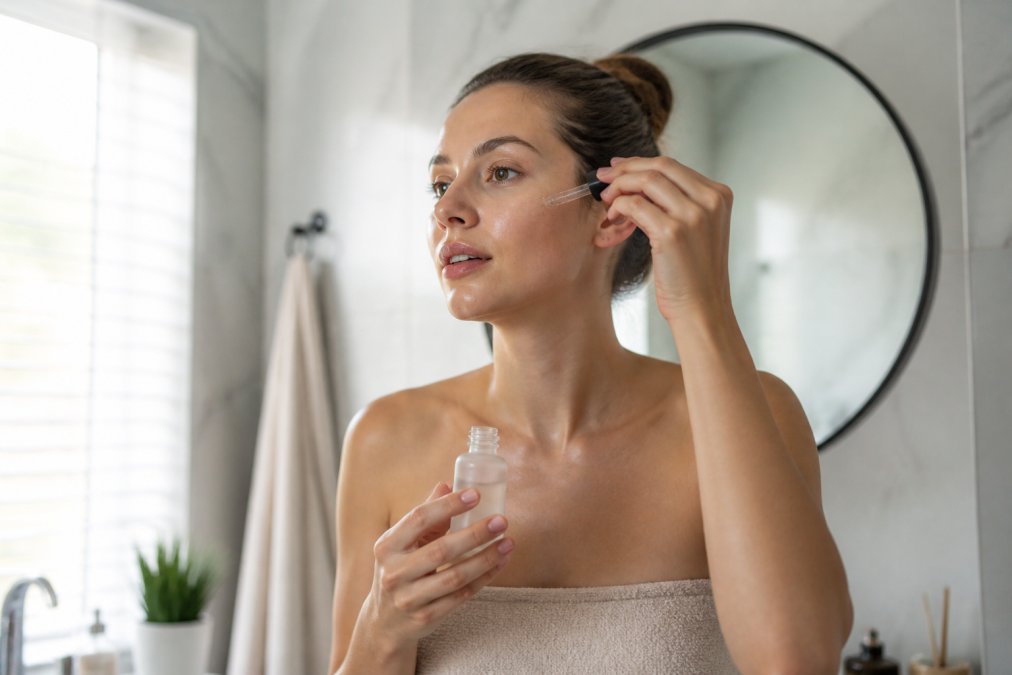
- Cleanse your face with a gentle cleanser and pat dry lightly.
- Apply niacinamide to dry skin before heavier creams.
- Wait two to three minutes for it to fully absorb.
- Continue with a hydrating cream to lock in moisture.
- In the morning, finish with sunscreen, which is mandatory in every routine.
- Start every other day if you have sensitive skin.
Concentrations and percentage content: what is safe
The safe range for daily use is between 2% and 5%. Higher concentrations do not automatically mean better results and can cause redness in sensitive skin.
| Concentration | Suitable for | When to use |
|---|---|---|
| 2% | Sensitive skin | Start of routine |
| 4% | Combination skin | Sebum and pore control |
| 5% | Oily skin | Acne and hyperpigmentation |
| 10%+ | Not recommended | Risk of irritation |
Niacinamide and retinol combination: how to combine them correctly
A niacinamide and retinol combination is safe, as long as both products are not applied simultaneously to freshly cleansed skin. The old warning that they interfere with each other comes from laboratory conditions that rarely occur in a real routine. In practice, the problem is not chemical incompatibility, but overloading the skin barrier when two active products are applied one on top of the other without waiting.
The practical solution is simple: niacinamide in the morning, retinol at night. If you prefer to use both in one session, wait for the first product to absorb completely before applying the second. With retinol concentrations above 0.3%, it is more reasonable to split them into different times of the day.
Compatibility with vitamin C
The combination with vitamin C (L-ascorbic acid) is the most frequently cited controversy. In a pure laboratory environment, high concentrations of both ingredients can form nicotinic acid, which causes skin redness. In a real cosmetic formula, however, the pH and concentrations are different, so the risk is low. If you still feel a stinging sensation, apply vitamin C in the morning and niacinamide at night, or choose a vitamin C derivative like ascorbyl glucoside, which is more stable and better tolerated.
Compatibility with AHA and BHA acids
There is no chemical incompatibility here, but there is a risk of over-exfoliation. If you use glycolic, lactic, or salicylic acid, apply niacinamide on a day when you are not peeling, or wait 20-30 minutes after the acid before continuing with niacinamide. In sensitive skin, combining them in the same routine stage often leads to redness, which is mistaken for an allergy.
Compatibility with benzoyl peroxide
Benzoyl peroxide is a strong antibacterial agent for acne and can oxidize niacinamide if both products are mixed directly on the skin. Applied in separate steps—for example, benzoyl peroxide as a spot treatment at night and niacinamide on the whole face in the morning—the two work without interference.
Scientific research and evidence of niacinamide's effectiveness
Scientific research and evidence for niacinamide have been accumulating for decades, which distinguishes it from many trendy ingredients. Its mechanism of action is described in dermatological literature, not just in marketing materials. Unlike most active ingredients, whose reputation relies on isolated studies, niacinamide has a long history of research across several different skin problems.
What the studies show
The most cited studies examine niacinamide in concentrations between 2% and 5%. In these ranges, a decrease in transepidermal water loss, improved elasticity, and visible evening of skin tone are observed. At concentrations around 4%, studies report a decrease in sebum secretion, which explains the effect on pores and acne. At 5%, a reduction in pigment spots is observed after several months of regular use.
Important note: higher concentrations do not lead linearly to better results. Studies do not show the superiority of 10% or 20% formulas over 5% for daily use, and side effects increase. Therefore, in dermatological practice, 5% is often accepted as the upper limit for a daily routine.
Mechanisms described in the literature
Niacinamide acts through several parallel pathways:
- Lipid synthesis, stimulates the production of ceramides and free fatty acids that build the intercellular cement of the epidermis.
- Melanin transfer, blocks the movement of melanin granules from melanocytes to keratinocytes without inhibiting the melanocytes themselves.
- Inflammatory pathways, reduces the activity of mediators associated with redness and inflammation in acne.
- Sebum secretion, regulates sebum production without drying out the skin.
According to a review of dermatological research on niacinamide, these mechanisms are described in numerous independent studies, which explains why the ingredient works on several problems simultaneously.
Where the evidence is weaker
Not everything about niacinamide is equally well-studied. The effect on deep wrinkles is less documented than the effect on skin tone and the barrier. Claims about "shrinking" pores are also not supported by research; the physical structure of pores does not change, and the visual effect comes from reduced clogging. Distinguishing between what is proven and what is marketing is important when choosing a product.
Official safety and usage information for cosmetic ingredients is published by the European Commission, CosIng database. If you are looking for an independent verification of a formula, the FDA's cosmetics information portal also provides guidelines on how active ingredients are evaluated.
For sensitive skin, dermatologists often recommend formulas with additional soothing ingredients like allantoin, which reduces redness and supports the repair of the protective film. Bellaskin uses such a combination in its collagen jelly and peeling ampoules to combine activity with tolerance.
Conclusion
The difficulty is not in finding niacinamide, but in choosing a formula that works with your skin rather than against it. Bellaskin offers solutions with niacinamide and allantoin that soothe redness, lighten dark spots, and unclog pores. The products contain Korean botanical extracts of marigold and astragalus and provide antioxidant protection.
Start with one step and see how your skin reacts. Explore the Bellaskin range.
Frequently Asked Questions
What does niacinamide do for facial skin?
Niacinamide (vitamin B3) strengthens the skin barrier, regulates sebum secretion, and reduces inflammatory processes. It evens out skin tone, brightens hyperpigmentation, and reduces the appearance of enlarged pores. Furthermore, it provides antioxidant protection while improving hydration and elasticity. It is suitable for oily, combination, and sensitive skin, and regular use can lead to a smoother texture and a radiant complexion.
What should niacinamide not be combined with?
Niacinamide pairs well with most active ingredients, including retinol and vitamin C, provided they are introduced gradually. Avoid simultaneous application with high concentrations of acids (AHA/BHA peels) in the same step, as this may cause irritation on sensitive skin. If you use strong exfoliants, apply niacinamide in a separate routine or wait 20-30 minutes between products.
How long does it take for niacinamide to work?
The first visible results from niacinamide usually appear after 2 to 4 weeks of regular use. Improvements in hydration and skin tone evening can take 8-12 weeks. Reducing hyperpigmentation and redness requires at least 3 months. It is important to apply it consistently morning and evening to see the full effect on the skin barrier and texture.
Is niacinamide suitable for sensitive skin?
Yes, niacinamide is suitable for sensitive skin, especially at concentrations between 2% and 5%. It strengthens the skin barrier and reduces redness, making it a good choice for irritated skin. Start with a lower percentage and apply it every other day until the skin gets used to it. If you experience burning or redness, reduce the frequency. Combine with soothing ingredients like allantoin for maximum comfort.