


Table of Contents
- What is sensitive skin and how to recognize it
- Why Korean skincare is suitable for sensitive skin
- Ingredients in Korean skincare that soothe the skin
- Korean skincare routine steps for sensitive skin
- How to choose a soothing face serum and cleanser
- Seasonal care and sun protection (SPF) for sensitive skin
- Frequently asked questions
Last updated: October 1, 2026
What is sensitive skin and how to recognize it
Sensitive skin is a condition in which the skin's barrier function is weakened and it reacts more sharply to external irritants. This is not a diagnosis, but a state that millions of women experience daily.
Symptoms usually appear within minutes of contact with an irritant. Here is how to tell if you have reactive skin:
- Redness and a burning sensation after washing
- Tightness and dryness immediately after cleansing
- Flaking on the cheeks and around the nose
- Reactions to products that were previously tolerated
- Small red spots for no apparent reason
If you recognize three or more of these signs, you most likely have sensitive skin. The problem is not with a single product, but with the fact that the protective barrier is compromised.
Main signs of reactive skin
Reactive skin responds quickly and acutely. Redness appears in minutes, not days. The burning sensation is stronger than simple dryness.
The key difference between dry and sensitive skin is the reaction time. Dry skin feels tight, but rarely burns. Sensitive skin burns to the touch and reddens easily.
Dermatologically tested products are a mandatory starting point. Hypoallergenic formulas reduce the risk of a reaction, but do not eliminate it entirely.
Why Korean skincare is suitable for sensitive skin
Korean skincare for sensitive skin focuses on hydration and soothing rather than aggressive treatment. This makes it a natural choice for reactive skin.
The philosophy is different. Instead of drying out and forcefully clearing the skin, it nourishes and repairs. Layers of light textures allow the skin to absorb active ingredients gradually.
Here is why these formulas work well for sensitivity:
- Low concentrations of active ingredients in a multi-layered routine
- Focus on hydration and restoring the barrier function
- Light textures that do not clog pores
- Ingredients like Centella Asiatica and Houttuynia cordata extract, which are aimed at soothing
pH balance also matters. Many Korean formulas maintain a slightly acidic environment close to the skin's natural state. This reduces irritation with daily use.
Ingredients in Korean skincare that soothe the skin
The ingredients in Korean skincare are aimed at soothing and regeneration. Here are the ones that work best for sensitive skin and their mechanisms.
Centella Asiatica contains asiaticoside and madecassoside, compounds that reduce inflammatory mediators and support collagen synthesis. This is why it is often found in serums for reddened skin.
Hyaluronic acid retains water in the upper layers of the skin. For sensitive skin, it is important to combine it with an occlusive agent (such as squalane or shea butter), otherwise, the water evaporates and the skin feels tight again.
Panthenol (provitamin B5) and ceramides strengthen the protective barrier. Ceramides restore the lipid matrix between cells, while panthenol reduces transepidermal water loss.
Niacinamide at a concentration of 2-5% strengthens the barrier and brightens dark spots. Above 10%, it often causes burning in sensitive skin, so start with a low percentage.
Other useful ingredients:
- Aloe vera for immediate soothing and moisturizing
- Houttuynia cordata extract for antioxidant protection
- Allantoin for softening and healing micro-injuries
- Beta-glucan (often from oats) for reducing redness
- Madecassoside in pure form for intensive soothing
According to a review of dermatological studies on Centella Asiatica, this extract shows a consistent anti-inflammatory effect on reactive skin.
Ingredients better avoided for sensitive skin
Some popular ingredients worsen the condition of reactive skin. Avoid them until your barrier is restored, and know what to replace them with.
Alcohol Denat. at the beginning of an ingredient list dries out and disrupts the lipid layer. Replace with water-based formulas or ones containing glycerin. If alcohol is listed toward the end, it is usually in such a small amount that it does not irritate.
Synthetic fragrances (Parfum/Fragrance) and essential oils with high concentrations (lemon, lavender, mint, citrus) contain terpenes and furocoumarins which, with a compromised barrier, trigger contact dermatitis. Replace with fragrance-free products or those with very low concentrations of neutral scents.
Physical scrubs with large particles (sugar, salt, ground nuts) create micro-tears. Replace with enzyme exfoliants (papain, bromelain) or a gentle PHA (gluconolactone).
Strong AHA and BHA acids above 10% (glycolic, lactic, salicylic) lead to burning and redness in sensitive skin. Replace with lower concentrations (5-8%) or gentler acids like mandelic and lactobionic.
Sulfates like SLS (Sodium Lauryl Sulfate) and, less frequently, SLES in cleansers destroy the barrier. Replace with amino acid surfactants (cocoyl glycinate, sodium cocoyl isethionate) or gentle glucosides.
Essential oils (tea tree, eucalyptus, rosemary) are often marketed as "natural," but they irritate sensitive skin. Replace with water-based extracts or pure active ingredients.
Physical filters with nanoparticles can cause clogging in some people, but for sensitive skin, mineral filters (zinc oxide, titanium dioxide) are usually better tolerated than chemical ones.
Korean skincare routine steps for sensitive skin
The Korean skincare routine follows the principle of applying products from thinnest to thickest. For sensitive skin, shorten the classic ten steps to five.
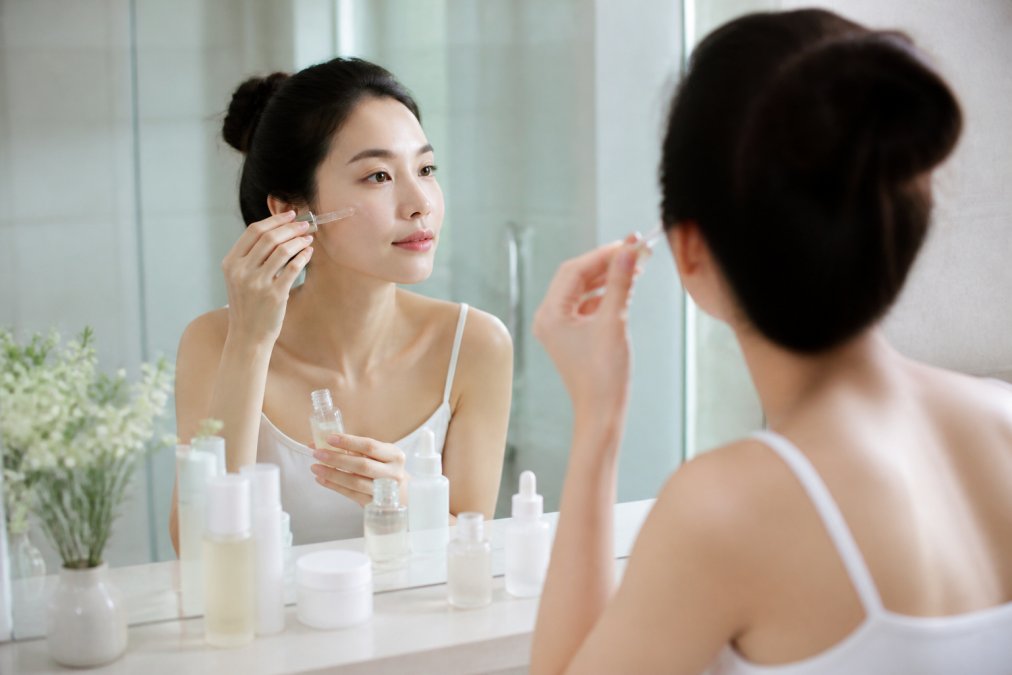
Here is the effective sequence:
- Cleansing oil to break down sunscreen and makeup
- Gentle foaming cleanser with a low pH
- Essence for initial hydration
- Soothing face serum with centella or niacinamide
- Cream to lock in moisture
- SPF protection every morning
How to patch test a new product before applying it to your entire face
A patch test is the most underrated step for sensitive skin. It takes three days and saves weeks of recovery.
Here is how to do it correctly:
- Apply a small amount behind the ear or on the inside of the elbow
- Wait 24 hours and check for redness or itching
- If there is no reaction, apply again and wait another 24 hours
- If there is still no reaction, test on a small area of the cheek
- Wait another 24 hours before applying to the entire face
How to choose a soothing face serum and cleanser
Choosing a soothing face serum and a cleanser determines whether your routine will work. Here are the criteria that matter.
| Criterion | Look for | Avoid |
|---|---|---|
| Cleansing | Oil-based, low pH | Sulfates, strong perfumes |
| Serum | Centella, panthenol, niacinamide | High alcohol, strong acids |
| Texture | Light, water-based, fast-absorbing | Heavy, sticky, clogging |
| Packaging | Pump or tube | Jar opened with fingers |
| Testing | Dermatologically tested | No test information |
Seasonal care and sun protection (SPF) for sensitive skin
SPF protection is essential in all seasons, but skin needs change with temperature, humidity, and exposure time. For sensitive skin, adapt not only the products but also the number of steps.
Winter (November - February)
Dry air from heating and the cold outside deplete the barrier. The skin loses water faster and redness intensifies when moving from warmth to cold.
- Replace the light cream with a thicker one containing occlusive ingredients (shea butter, squalane, ceramides).
- Apply a hydrating serum under the cream while the skin is still damp after washing.
- Use SPF 30+ every day; UV rays do not disappear in winter, and snow reflects up to 80% of them.
- Avoid hot water when washing; it dissolves lipids and worsens tightness.
- If you use a humidifier, maintain humidity between 40-60%.
Spring (March - May)
Temperatures rise, but the skin is still weakened from winter. Do not switch abruptly to light textures.
- Return to light textures gradually; first switch the cream, then the serum.
- Resume regular use of SPF 50 if you used a lower one during winter.
- If you use acids, reduce frequency to once a week until the skin adapts to the stronger sun.
- Avoid exfoliants on days with a high UV index.
Summer (June - August)
Sweating, sun, and air conditioning put stress on the skin. Redness increases, and heavy creams clog pores.
- Choose a gel or light emulsion instead of a thick cream.
- SPF 50 with mineral filters (zinc oxide, titanium dioxide) is gentler for reactive skin than chemical ones.
- Reapply SPF every two hours when in the sun, even if it is cloudy.
- If wearing makeup, use SPF underneath or a mineral foundation with added protection.
- Avoid essential oils in sunscreens; some (citrus) are phototoxic.
- After sun exposure, apply a soothing gel with aloe or centella.
Autumn (September - October)
The skin recovers after summer. This is a good time to reintroduce active ingredients if you have stopped them.
- Bring back niacinamide and lower concentrations of acids.
- Start restorative masks 1-2 times a week.
- Continue SPF 30+ every day.
- If the skin is reddened from summer, wait for it to calm down before introducing new active ingredients.
How to choose an SPF for sensitive skin
Mineral filters (zinc oxide, titanium dioxide) are better tolerated because they do not penetrate the skin and do not cause allergic reactions. Chemical filters (avobenzone, oxybenzone) can irritate a compromised barrier.
Frequently Asked Questions
What are the best ingredients in Korean cosmetics for sensitive skin?
Look for formulas with centella asiatica, hyaluronic acid, panthenol, ceramides, aloe vera, houttuynia cordata extract, and antioxidants. These ingredients soothe redness, strengthen the barrier function, and provide hydration without irritation. Avoid products with high concentrations of alcohol, fragrance, and harsh exfoliants. Korean cosmetics often combine these gentle ingredients into lightweight formulas suitable for a daily routine.
How do I know if my skin is sensitive?
Sensitive skin reacts with redness, stinging, tightness, or flaking after applying a new product or when the weather changes. If these symptoms occur frequently and your skin is easily irritated, you likely have reactive skin. Perform a patch test on a small area before using any new product, and avoid ingredients that cause discomfort.
Are Korean cosmetics safe for people with rosacea or dermatitis?
Many Korean products are dermatologically tested and hypoallergenic, making them suitable for sensitive skin, including for rosacea or dermatitis. However, for diagnosed conditions, it is important to consult a dermatologist before introducing new products. Choose fragrance-free and alcohol-free formulas with soothing ingredients like panthenol and ceramides.
How do I test a new Korean product before applying it to my entire face?
Apply a small amount of the product to the inside of your wrist or behind your ear and wait 24 to 48 hours. If no redness, itching, or stinging occurs, the product is safe for use. For a serum or essence, test it on a small area of the face, such as along the jawline, and monitor for a reaction. This method reduces the risk of irritation.