


Table of Contents
- Why acne treatment takes time: the skin's cellular cycle
- Stages of acne treatment: what happens week by week
- Factors that influence the speed of results
- Korean cosmetics for acne: how they fit into a therapeutic plan
- When to see the effect of niacinamide and why it is a key ingredient
- When to change therapy: signs that the current approach is not working
- The psychological aspect of patience and how not to give up prematurely
- Errors that slow down the healing process
- Frequently Asked Questions
Last updated: September 22, 2026
Why acne treatment takes time: the skin's cellular cycle
How long for results with acne is the question every woman with imperfections asks herself after the first application of a new product. The answer is not in marketing, but in biology. The skin's cellular cycle, the time it takes for a new cell layer to rise from the dermis to the surface, takes an average of between 28 and 40 days for an adult. This means that whatever active ingredient you use, it works on cells that have not yet reached the epidermis.
In acne, this cycle is disrupted. Oil accumulates, pores clog, comedones form, and inflammation deepens the process. To see real results, at least one full regeneration cycle must pass. That is why we explain a simple rule: the first weeks are for adaptation, not for evaluation.
American Academy of Dermatology resource on acne treatment timelines
Stages of acne treatment: what happens week by week
An acne therapeutic plan is not linear. It goes through three distinct phases, each with its own expectations. Here is what a realistic schedule looks like.
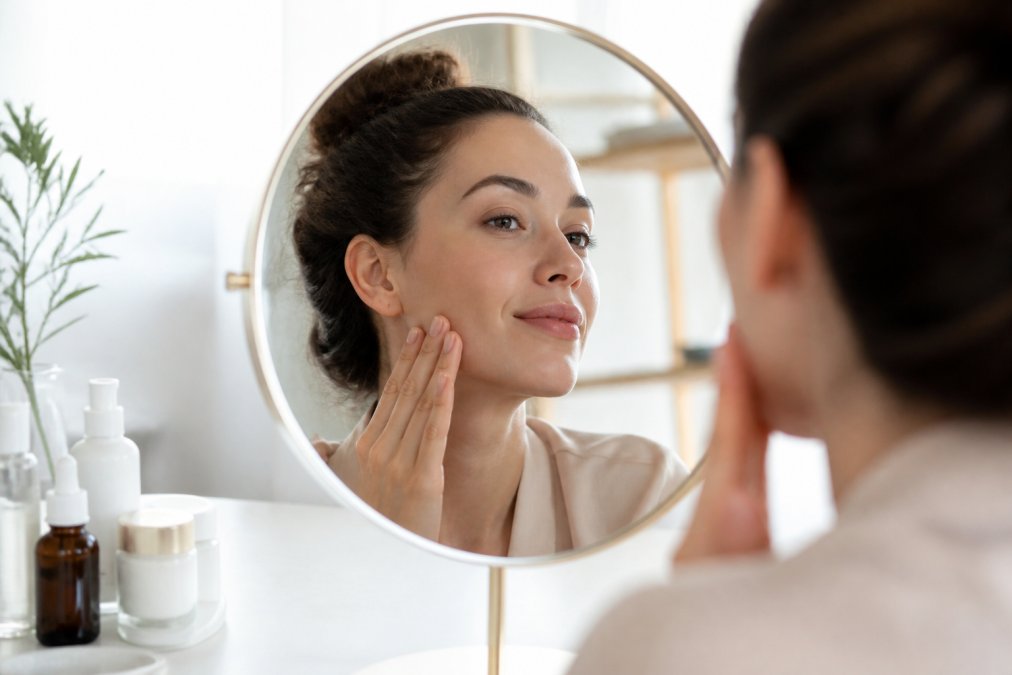
The first 2-4 weeks: adaptation period and possible worsening
The first month is the most difficult psychologically. The skin adapts to active ingredients, and with retinoids and exfoliating acids, a temporary flare-up of inflammation is possible. This is not a failure of the therapy, but a normal reaction of the skin barrier.
Weeks 4-8: first visible improvements
This is when the first real results for acne begin to appear. Inflamed lesions decrease, redness calms down, and the skin's texture smoothes out. Blackheads and comedones begin to decrease visibly.
Weeks 8-12 and beyond: stabilization and maintenance care
Between the second and third month, the skin reaches a stable state. Hyperpigmentation and acne scars fade more slowly because they require several more cellular cycles. After this, the therapy transitions into maintenance care.
Factors that influence the speed of results
The same product yields different results for different women. The difference is rarely the product itself.
Severity of acne and inflammatory processes
Mild comedonal acne responds faster than deep inflammatory acne. When inflammation has affected the dermis, and not just the epidermis, regeneration requires more time and often necessitates a dermatological examination. For inflammatory papules and pustules, the first improvements can be seen after 4-6 weeks, while for nodular acne, the timeline extends to 12-24 weeks.
The role of consistency in therapy
Consistency of use is the most underestimated factor. Skin does not work on the principle of compensation: missed applications cannot be made up for with a double dose. Consistency, not intensity, determines the speed of results. If you miss 3 days a week, the effect is delayed by about 30%.
Impact of sleep and stress
Cortisol, the stress hormone, stimulates oil glands and worsens inflammation. With chronic sleep deprivation (less than 6 hours) and high stress levels, sebum production increases and lesion healing slows down. Studies show that students during exam sessions have worse acne than during calmer periods. The practical takeaway: 7-8 hours of sleep and stress management (breathing, walking, limiting caffeine) can accelerate results by 2-4 weeks.
The role of diet
High-glycemic foods (white bread, sweets, sodas) spike blood sugar and insulin, which stimulates sebum production and inflammation. Dairy products, especially skimmed, are also linked to worse acne in some people. Complete avoidance is not necessary, but reducing these foods can improve therapy results by 10-20% over 8-12 weeks.
Age and hormonal status
In teenagers, acne is often influenced by puberty hormones, and therapy may take longer. For women over 25, hormonal acne (around the chin and jawline) often requires a combined approach, local treatment plus hormonal evaluation by a gynecologist or endocrinologist. If acne is cyclical and worsens before menstruation, this is a signal of a hormonal component.
Genetic predisposition
If your parents have a history of severe acne, the probability that your therapy will take longer is higher. Genes influence the size of oil glands, the speed of cell division, and the immune response. This does not mean that treatment won't work, but that patience must be greater.
Korean cosmetics for acne: how they fit into a therapeutic plan
Korean cosmetics for acne work best as a supplement to a therapeutic plan, not as a replacement. Their strength lies in their gentleness: hydration, calming redness, and strengthening the skin barrier without weighing down already irritated skin.
This is where the practical difference between cosmetic care and medical treatment appears. Medical treatment acts on the mechanism of acne. Cosmetic care creates the conditions in which that mechanism works better.
Peel Shot White Rice Peeling Ampoule →
When to see the effect of niacinamide and why it is a key ingredient
The effect of niacinamide usually manifests between the fourth and eighth week with regular use. Niacinamide is a form of vitamin B3 and works simultaneously on several fronts: it regulates oil secretion, strengthens the skin barrier, and brightens post-acne hyperpigmentation.
Unlike retinoids, niacinamide rarely triggers a purging period. This makes it suitable for sensitive skin and for women who cannot tolerate aggressive antibiotic therapy or retinoids.
Journal of Cosmetic Dermatology overview of niacinamide in skincare
If you are looking for a product that combines niacinamide with gentle exfoliation, Peel Shot White Rice Peeling Ampoule unclogs pores and removes blackheads without redness, for 29.99 BGN.

When to change therapy: signs that the current approach is not working
Changing therapy is justified when there is no change after 12 weeks of regular use, when new deep nodules appear, or when the skin barrier is permanently damaged.
However, there is a clear boundary between "not working" and "hasn't started working yet." The first four weeks are not grounds for a change. If the condition worsens significantly after the eighth week, a consultation with a dermatologist is a wiser step than yet another new product.
The psychological aspect of patience and how not to give up prematurely
Patience in acne treatment is not a matter of character, but of setting expectations correctly. The majority of prematurely abandoned therapies are stopped not because they don't work, but because the result didn't come in the expected timeframe.
Practical approach: keep a short diary with photos every two weeks in the same lighting. Acne changes are gradual and the daily mirror doesn't reflect them. Photos objectively show what has happened over a month.
Errors that slow down the healing process
| Error | What it causes | How to fix it |
|---|---|---|
| Changing the product every 2 weeks | Interrupts the cell cycle | Give it at least 8 weeks |
| Excessive use of active ingredients | Irritation and damaged barrier | Introduce them gradually |
| Lack of sun protection | Deepens hyperpigmentation | Apply every day |
| Squeezing lesions | Scars and new inflammation | Let them absorb |
| Ignoring hydration | Delayed regeneration | Hydrate regularly |
Sun protection deserves separate attention. Without it, brightening ingredients lose their purpose because new spots appear faster than the old ones fade.
World Health Organization guidance on ultraviolet radiation and skin
Patience is the most difficult part of acne treatment, but also the most influential. If you are looking for care that works with the skin, not against it, check out Bellaskin products: Korean formula with extracts of calendula and astragalus, niacinamide, and allantoin for calming redness, plus antioxidant protection against the environment. Over 4,000 satisfied customers and a 4.9/5 rating speak for themselves. Buy now and give your skin the time it needs.
Frequently Asked Questions
How long does it take for skin to clear up from acne completely?
Full acne clearance takes between 6 and 12 weeks for mild to moderate cases, and in more severe cases, it can take 3 to 6 months. This is due to the skin's cellular cycle, which is about 28 days. The first visible improvements usually appear after 4-6 weeks of regular use of suitable products and active ingredients like retinoids or niacinamide.
Why does acne get worse at the beginning of treatment?
Worsening at the beginning is a normal reaction known as the adaptation period. Active ingredients accelerate the cell cycle and bring hidden comedones and inflammation to the surface. This may last 2-4 weeks. It is important not to stop the therapy prematurely, but to maintain it regularly. If the worsening is severe or lasts longer than 6 weeks, consult a dermatologist.
When are the first results from Korean acne cosmetics visible?
The first results from Korean acne cosmetics are usually noticeable after 2-4 weeks, with the skin becoming smoother and more hydrated. A noticeable reduction in inflammation and blackheads takes 6-8 weeks. Korean formulas often contain niacinamide, allantoin, and plant extracts that work gently but require consistency. Maintenance care is key for a long-lasting effect.
Is it possible for acne to disappear in one week?
Acne cannot disappear completely in a week because the inflammatory processes under the skin's surface require time to calm down. Products with niacinamide can reduce redness and improve texture in a few days, but the complete clearing of comedones and scars takes weeks to months. A realistic approach and regular use are more important than quick but short-lived solutions.