


Table of Contents
- Why Korean skincare handles dark spots better than standard care
- How dark spots appear: the melanin logic that determines your choice
- Korean skincare with Vitamin C: what role it plays in evening out skin tone
- SPF for the face against spots: why everything else is lost without it
- Brightening serums and ampoules: how to combine them safely
- Even skin tone routine: 5 steps with products and prices
- Frequently Asked Questions
Last updated: September 14, 2026
Why Korean skincare handles dark spots better than standard care
Korean skincare for dark spots earns trust because it addresses the problem on several levels simultaneously: it doesn't just bleach the spot, but works on the skin barrier, inflammation, and protection against UV rays. This Bellaskin guide is a practical manual on how to build a routine that yields results without irritating the skin.
The difference lies in the philosophy. The Western approach often relies on one strong active and aggressive exfoliation. The Korean routine focuses on layers of light formulas that build up: hydration, antioxidant protection, brightening, and SPF protection. The skin is not "shocked" but slowly guided toward an even tone.
This is also why, for many women, the result looks more sustainable. The spot doesn't return because the cause of its appearance is addressed, not just the symptom.
How dark spots appear: the melanin logic that determines your choice
Melanin is the natural pigment that protects the skin from UV damage. In hyperpigmentation, its production is intensified locally and deposited unevenly, which leaves visible dark areas.
The process is called melanogenesis and occurs in three stages. First, UV rays or inflammation activate the enzyme tyrosinase. Second, tyrosinase converts the amino acid tyrosine into melanin. Third, the finished melanin is transported to surface cells and becomes visible as a spot.
Each active ingredient acts on a different stage of this chain. Niacinamide blocks the transfer of melanin to the surface. Vitamin C and arbutin inhibit tyrosinase activity. Retinol accelerates cell turnover so that pigmented cells are removed faster.
Understanding this logic changes your choice. If you combine two actives that act on the same stage, you get irritation without additional results.
Hyperpigmentation and treatment: why topical brightening is not enough without protection
Hyperpigmentation is a condition in which the skin produces excessive amounts of melanin in specific areas, leading to dark spots with uneven borders.
Topical brightening without UV protection is the most common reason routines fail. If you apply a serum every day but go out without SPF, UV rays activate tyrosinase again and the result is wiped out. Many women conclude that "the product doesn't work" when, in fact, the final step is missing.
Korean skincare with Vitamin C: what role it plays in evening out skin tone
Vitamin C is one of the best-researched antioxidants in skincare. It neutralizes free radicals, suppresses tyrosinase activity, and supports collagen synthesis, which improves skin elasticity and firmness.
The problem is that "Vitamin C" on the label doesn't mean the same thing. In Korean formulas, several different forms are found, and each has a different profile of stability, pH, and tolerance.
Which forms of Vitamin C are found in Korean formulas
- L-Ascorbic Acid. The most active and well-researched form. It works at an acidic pH, usually between 2.5 and 3.5 (pubmed.ncbi.nlm.nih.gov). The downside is that it is unstable: it oxidizes upon contact with light and air and darkens when it loses activity. On sensitive skin, it can cause redness and stinging, especially at concentrations above 15%.
- Ascorbyl Glucoside. A water-soluble derivative with a more neutral pH and much higher stability. It works more slowly because the skin must first convert it. A good choice for sensitive skin and for a morning routine where the product stays open for months.
- Ascorbyl Tetraisopalmitate. An oil-soluble form that penetrates the lipid barrier well and rarely irritates. It is often found in combination with Vitamin E and ferulic acid because they stabilize each other.
- 3-O-Ethyl Ascorbic Acid. A stable derivative used in higher concentrations without an acidic pH. Suitable for routines that already contain exfoliants.
- Magnesium Ascorbyl Phosphate. A gentle form, often in Asian formulas for sensitive skin. The result is gradual.
How to choose a concentration based on your skin
The practical rule is to start low and increase slowly. With pure L-ascorbic acid, the starting point for most people is between 5% and 10% (pubmed.ncbi.nlm.nih.gov). Concentrations from 15% to 20% give faster visible results, but also a significantly higher risk of redness, peeling, and temporary intensification of pigmentation due to inflammation.
If your skin is sensitive or you are already using retinol or acids, derivatives are a wiser choice. If you are looking for maximum effect on dark spots and tolerate acidic formulas, L-ascorbic acid remains the most direct path, but only provided the product is in opaque packaging with a pump or dropper, not in a jar with a wide mouth.
Why Vitamin C is rarely used alone in Korean formulas
Combining is not marketing, but chemistry. Vitamin C is unstable on its own, and certain ingredients keep it active longer:
- Vitamin E and ferulic acid. A classic trio where the antioxidants regenerate each other and the formula lasts longer in the light.
- Niacinamide. Different mechanisms against melanin; Vitamin C inhibits tyrosinase, Niacinamide blocks the transfer of finished melanin to the surface. The combination is logical and usually well tolerated.
- Hyaluronic acid and glycerin. They are not active against pigment, but reduce the sensation of tightness and irritation, which allows the routine to be maintained for months.
Practical rules for use
Apply Vitamin C in the morning, before moisturizer and before SPF. The morning time makes sense because the antioxidant works during the day while UV load is highest. If the product has an acidic pH, wait a minute or two before the next step so it isn't neutralized.
Store the bottle in a dark, cool place, away from a window. If the liquid has darkened to brown or orange, activity has dropped significantly; this is not a sign of strength, but of oxidation.
SPF for the face against spots: why everything else is lost without it
SPF protection is the most important step in the routine against pigment spots. Without it, brightening active ingredients work against a process that continues to be triggered every day.
UV rays cause photoaging and directly activate melanogenesis. Even brief exposure outdoors, a walk to the store, or a car ride is enough to maintain the spots. That is why dermal care manufacturers recommend daily protection, regardless of the season.
How high of a factor is needed and how to apply it correctly
For daily urban use, an SPF 30 protective factor is sufficient (pubmed.ncbi.nlm.nih.gov). If you spend a long time outdoors or have darker spots, SPF 50 is a wiser choice.
Application matters no less than the factor. Most people use too little product. The practical rule is two finger lengths for the face and neck. Apply SPF as the last step of the morning routine and reapply every two to three hours with prolonged exposure.
Brightening serums and ampoules: how to combine them safely
Serums and ampoules are concentrated formulas that deliver active ingredients to a deeper level than creams. An ampoule is a more concentrated version of a serum and is usually used in courses, for example, two to four weeks, not continuously.
The key is not in the number of active ingredients, but in whether they act at different stages of melanogenesis and whether the skin can handle the load. Two actives with a different mechanism work well together. Two actives with the same mechanism or two strong exfoliants in one routine lead to a compromised skin barrier, and then pigmentation worsens rather than fades.
Why some combinations are problematic, not just "not recommended"
- Vitamin C + retinol at the same time. Vitamin C works at an acidic pH, retinol at a more neutral one. Mixed, the two neutralize each other and only irritation remains. Separating them morning/evening solves the problem.
- Retinol + AHA/BHA. Both accelerate cell turnover. Together, they remove the protective lipid layer, which leads to redness, stinging, and often darker marks due to inflammation.
- Benzoyl peroxide + retinol. Benzoyl peroxide is a strong oxidizer and deactivates retinol, and the combination is significantly irritating. If you use both, rotate them on different nights.
- Niacinamide + Vitamin C. For a long time, it was thought they hindered each other. Modern formulas work at similar pH environments and the combination is safe and logical; Niacinamide blocks melanin transfer, Vitamin C inhibits tyrosinase.
- Arbutin + Niacinamide. Two different mechanisms against melanin, usually well tolerated. Suitable for sensitive skin that cannot handle acids.
Protocol for weekly rotation
The most reliable model is not to put everything in one evening. A working rhythm looks like this:
- Morning, every day: Vitamin C (or derivative) and SPF.
- Evening, regularly: Niacinamide or arbutin serum, light actives that do not require a break.
- Evening, two to three times a week: Retinol or exfoliating ampoule, but not both on the same evening.
- One evening a week: only hydration and soothing ingredients, no actives. This is not a missed step, but part of the protocol.
If the skin is sensitive, start with one active and maintain it for two-three weeks before adding a second. The introduction of retinol or acid happens after the base routine no longer causes redness.
How to recognize that your barrier is compromised
There are clear signals that the load is too much: a stinging sensation when applying products that didn't irritate before; redness that doesn't disappear in an hour or two; dryness and slight peeling on the cheeks; and, most misleading, new dark spots or darkening of existing ones. The latter happens because inflammation itself activates melanogenesis.
With these signs, stop all actives for one to two weeks and stick only to cleansing, hydration, and SPF. After that, reintroduce one active at a time, with lower frequency.
Even skin tone routine: 5 steps with products and prices
Consistency matters more than the number of products. Five steps are enough if each of them is applied regularly and in the correct order.
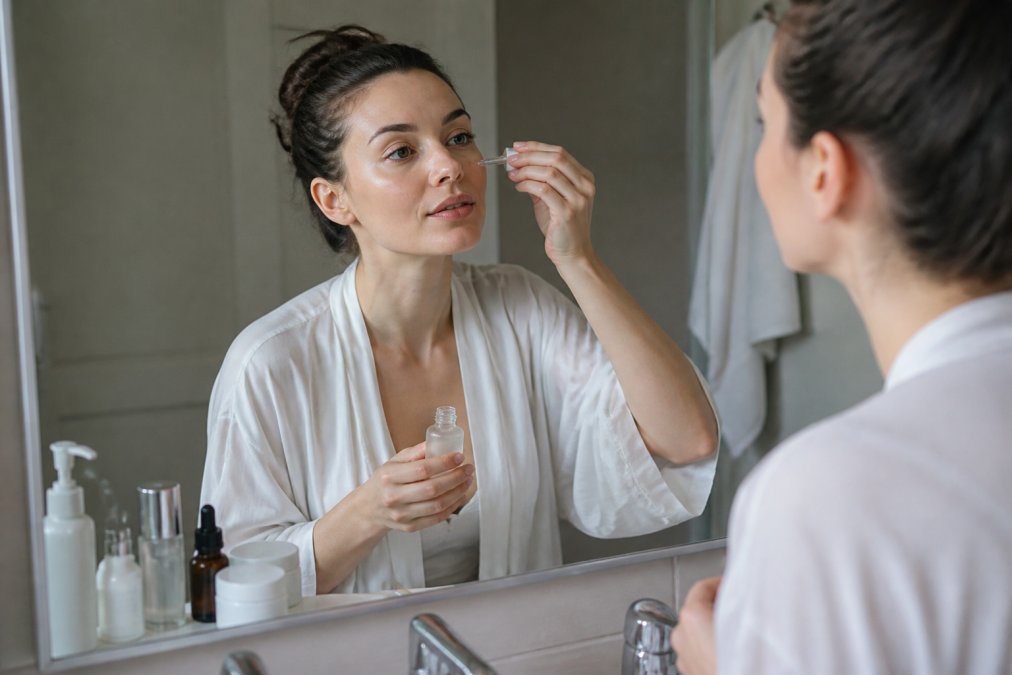
- Cleansing. A gentle, sulfate-free gel, morning and evening. The goal is to remove sebum without disrupting the skin barrier.
- Activating serum. Vitamin C in the morning, niacinamide or retinol in the evening. Apply to slightly damp skin for better absorption.
- Hydration. A lightweight cream or gel with hyaluronic acid. Hydrated skin regenerates faster and reacts more calmly to active ingredients.
- Exfoliation, twice a week. This includes Bellaskin’s White Rice Peel Shot Ampoule, priced at 29.99 BGN. The formula unclogs pores and smoothes the surface without redness, which is a rarity in exfoliating products.
- SPF protection every morning. At least SPF 30, applied in sufficient quantity.
If you are looking for a starting point, the combination of the peel ampoule and daily SPF covers the two most important steps. The product features a Korean formula with calendula and astragalus extracts, contains niacinamide and allantoin, and provides antioxidant protection.
Dark spots do not disappear in a week, and this is exactly where most people give up. Sustainable results come from a routine you can maintain for months, not from an aggressive course that burns the skin.
Bellaskin offers exactly that: formulas with niacinamide, allantoin, and Korean plant extracts that lighten dark spots, soothe redness, and strengthen the skin's natural defense. Over 4,000 customers have already built their routine with Bellaskin products and rated it 4.9 out of 5.
Start with the White Rice Peel Shot Ampoule and build a routine that evens out your complexion without redness.
Frequently Asked Questions
Which ingredients in Korean cosmetics help the most with dark spots?
Niacinamide is among the most well-researched: it reduces the transfer of melanin to the skin's surface. Vitamin C acts as an antioxidant and brightens existing spots. Arbutin limits melanin production, while retinol accelerates cell turnover. The combination of niacinamide and vitamin C in one routine yields the most noticeable results for an uneven complexion. Add SPF daily, because without protection, active ingredients lose their effect.
How long does it take to remove pigment spots with Korean cosmetics?
The first changes in skin tone are noticeable after 4 to 6 weeks of regular use. Deeper acne or sun spots require 3 to 6 months. The key factor is consistency: if you skip SPF even for a few days, the process regresses. Products like the white rice peel ampoule accelerate exfoliation and even out the tone faster, but only if used according to the instructions without overdoing it.
Why is SPF mandatory when treating hyperpigmentation?
Ultraviolet rays activate melanocytes and produce new melanin, which darkens existing spots and creates new ones. Without SPF protection, active ingredients work against a process that the sun is constantly renewing. Use factor 50 every day, including on cloudy days and in winter. Apply it as the last step of your morning routine and reapply every two hours if you are spending long periods outdoors.
Are Korean cosmetics suitable for sensitive skin with spots?
Yes, as long as you avoid aggressive formulas. Korean products often contain centella asiatica, madecassic acid, and allantoin, which soothe the skin and strengthen the barrier. Start with one active product at a time and wait two weeks before adding a second. Test on a small area behind the ear. If you feel stinging or redness, reduce the frequency of use instead of stopping completely.