


Table of Contents
- Types of acne scars and how to identify them
- Professional procedures for acne scar removal
- Laser scar removal price and factors
- Korean cosmetics for acne scars: what works
- Niacinamide for fading spots and texture
- Skin recovery after procedures and home care
- Psychological aspect and quality of life
- Conclusion
- Frequently asked questions
Last updated: September 19, 2026
Types of acne scars and how to identify them
Removing acne scars in 2026 starts with a simple rule: first, understand exactly what type of scar you have.
Acne scars are not all the same. They are divided into three main groups, each requiring a different approach.
Atrophic scars are depressions in the skin. They occur when inflammation destroys collagen in the dermis and the skin cannot fully regenerate.
Hypertrophic scars are raised, firm formations. They are less common and are often the result of excessive collagen production.
Post-acne pigmentation is not a true scar. It is a dark spot left behind after a pimple. Unlike atrophic scars, it often fades over time and responds well to home care.
Professional procedures for acne scar removal
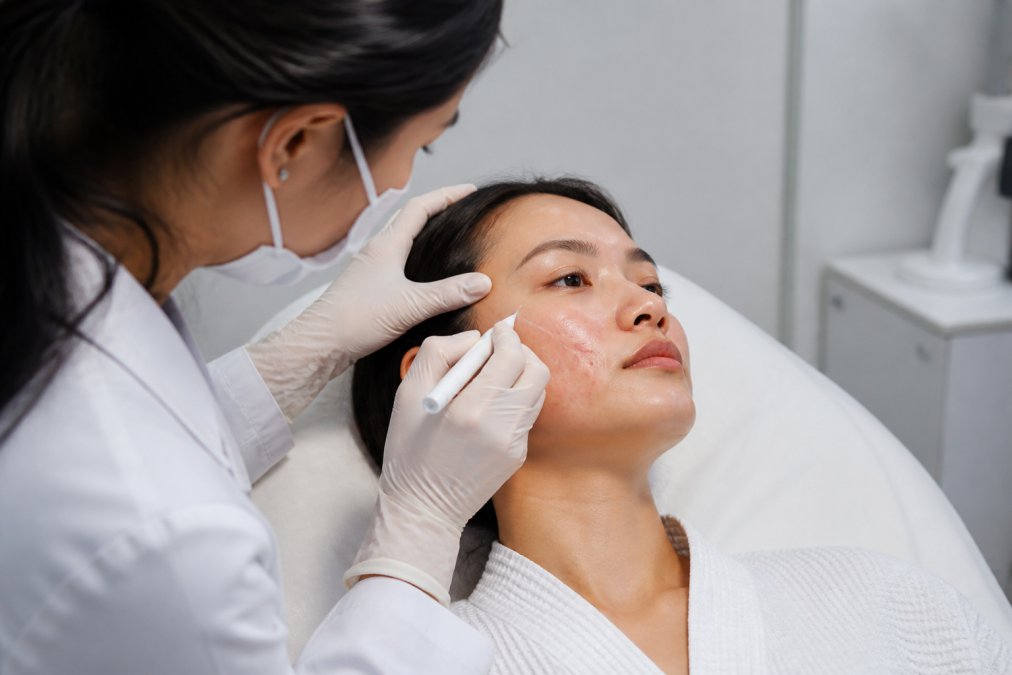
Professional procedures stimulate neocollagenesis, i.e., the building of new collagen, and restructure the skin surface. The choice of method depends on the type of scar, phototype, and the time you can dedicate to recovery.
Laser resurfacing and fractional CO2 laser
Fractional CO2 laser creates microscopic zones in the epidermis and dermis that trigger the skin's natural regeneration. Untreated columns remain around the treated areas, which speeds up healing compared to full resurfacing.
The procedure requires local anesthesia, and in the case of deeper settings, sedation. The recovery period includes erythema, swelling, and exfoliation within 5 to 7 days. Pigmentation can remain visible for up to two weeks. Most patients need 2 to 4 sessions at intervals of 4 to 6 weeks.
Microneedling and radiofrequency therapy
Microneedling uses fine needles to create controlled micro-injuries. The body responds by stimulating fibroblasts and producing collagen. With RF microneedling, the needles simultaneously deliver radiofrequency energy into the deep layers, which enhances the effect on texture and enlarged pores.
Needle-free radiofrequency therapy adds heat to the dermis and is suitable for light scars and sagging skin. Recovery is minimal, with redness for a few hours.
Combined protocols
A common approach is: fractional CO2 laser for deep atrophic scars, followed by RF microneedling for texture and pores. A recovery period of 4 to 8 weeks is included between procedures.
| Procedure | Suitable for | Sessions | Recovery |
|---|---|---|---|
| Fractional CO2 laser | Atrophic scars | 2-4 | 5-7 days |
| RF microneedling | Texture and pores | 3-5 | 2-3 days |
| Microneedling | Light scars, texture | 4-6 | 1-2 days |
| Radiofrequency therapy | Light scars, sagging | 3-5 | Immediately |
| Laser resurfacing | Pigmentation | 2-3 | 3-5 days |
Preparation and contraindications
Preparation begins 2 to 4 weeks before the procedure. Retinoids, acids, and exfoliants are stopped. Sun protection with a high factor is mandatory, and if there is a tendency for herpes, prophylaxis is prescribed.
Main contraindications:
- Active acne infection or inflammation
- Pregnancy and breastfeeding
- Tendency toward keloids
- Isotretinoin intake in the last 6 months
- Active-phase autoimmune diseases
- Recent sun or tanning bed exposure
Results and expectations
Improvement is gradual. The first visible changes appear 4 to 6 weeks after the procedure, with the full effect occurring 6 to 12 months later as the collagen remodels. A realistic goal is the improvement of texture and scar depth, not their total disappearance.
Laser scar removal price and factors
The price of laser scar removal depends on several factors. The area of treatment, the number of sessions, and the clinic determine the final amount.
In practice, most patients need several visits. Therefore, the total investment often exceeds the price of a single procedure.
Factors affecting the price:
- Size of the treated area
- Number of sessions required
- Type of laser
- Specialist's experience
- Geographical location of the clinic
Korean cosmetics for acne scars: what works
Korean cosmetics for acne scars work best for pigmentation and texture, not for deep atrophic scars. They are excellent for maintenance after professional procedures.
Active ingredients are key. Look for formulas with niacinamide, allantoin, and plant extracts.
White rice peeling ampoule for even skin tone
Bellaskin's white rice peeling ampoule is created for women who want not just clearer skin, but skin that glows, looks young, and feels healthy from the very first application. The formula removes blackheads and tightens and unclogs pores.

The product provides overall exfoliation without redness and deep hydration. The price is 29.99 BGN.
Niacinamide for fading spots and texture
Niacinamide for fading spots is one of the best-researched ingredients in skincare. It reduces melanin production and evens out skin tone.
Regular use also improves skin texture. Niacinamide strengthens the barrier and reduces redness.
Peel Shot White Rice Peeling Ampoule →
How to use it correctly:
- Start with a low concentration
- Apply in the evening before a moisturizer
- Use sunscreen during the day
- Be consistent for at least 8 weeks
Skin recovery after procedures and home care
Skin recovery after procedures requires patience and proper care. The first 7 days are important for the final result. Mistakes during this period can lead to pigmentation and delayed healing.
The first 72 hours
The skin is most vulnerable. Avoid sun, heat, saunas, and intense physical activity. Cleanse with a gentle product free of fragrance and alcohol. Apply a soothing cream with panthenol or Centella asiatica.
Do not touch or peel the skin. Exfoliation should happen naturally.
Days 4 to 7
Redness decreases. You can resume light hydration with hyaluronic acid. Still avoid active ingredients like retinol, AHA, and BHA acids.
Week 2 and beyond
Gradually return to a normal routine. Introduce active ingredients one by one, with an interval of several days. Niacinamide is a good choice for evening out skin tone and strengthening the barrier.
Hydration and sun protection
Hydration is the foundation. Use gentle products without alcohol or fragrances. Sunscreen is not optional; UV rays intensify pigmentation and slow healing. Apply SPF 50 every 2 hours, even on cloudy days.
Home maintenance routine
Once the skin has recovered, the routine should maintain the result and prevent new scars.
Morning:
- Gentle cleansing
- Antioxidant (vitamin C)
- Moisturizer
- SPF 50
Evening:
- Double cleansing
- Niacinamide or retinol (not together at first)
- Moisturizer
Once a week:
- Gentle enzyme peel
Prevention of new scars
- Do not squeeze pimples
- Cleanse skin regularly
- Avoid heavy oils
- Monitor your diet
- Change your pillowcase regularly
- Avoid touching your face
Diet and lifestyle
Diet affects the skin's ability to regenerate. Foods rich in vitamin C, zinc, and omega-3 fatty acids support collagen synthesis and reduce inflammation.
Limit sugar and processed foods. They can intensify inflammatory processes. Drink enough water and sleep 7 to 8 hours; skin regeneration is most active during sleep.
Psychological aspect and quality of life
Acne scars affect self-esteem more than most people admit. Many women avoid photos, dates, and public places.
This psychological burden is real. Acknowledging it is the first step toward a solution.
Working with a dermatologist and having realistic expectations helps. Progress comes gradually, but it does come.
Conclusion
Acne scars do not disappear overnight. But with the right plan and consistency, results will come.
Bellaskin offers gentle yet effective skincare. The white rice peeling ampoule removes blackheads and unclogs pores. The formula with niacinamide and allantoin soothes redness and lightens dark spots.
Buy now and start the journey to smoother and more radiant skin.
Frequently Asked Questions
What are the most effective methods for removing acne scars in 2026?
The most effective methods depend on the type of scars. For atrophic scars, fractional CO2 laser, microneedling, and radiofrequency therapy are used. For post-acne pigmentation, niacinamide, Korean white rice cosmetics, and regular exfoliation work well. A combination of professional procedures and home care provides the best result. It is important to have an individual consultation with a dermatologist to create a treatment plan tailored to your skin type.
Can Korean cosmetics help in fading scars?
Yes, Korean cosmetics are effective at fading spots and improving texture. Products with niacinamide, allantoin, and plant extracts stimulate skin regeneration and even out skin tone. White rice peeling ampoules remove blackheads and unclog pores without causing redness. Note that Korean cosmetics work best for post-acne pigmentation and mild scars, while deep atrophic scars require professional procedures.
How long does it take to completely remove acne scars?
The time depends on the type and depth of the scars. With home care using niacinamide and Korean cosmetics, the first results are visible after 4-6 weeks. Professional procedures like laser resurfacing require 3-5 sessions at 4-6 week intervals. The recovery period after a procedure is 3 to 10 days depending on the intensity.
How can we prevent new scars from appearing after acne?
Prevention is key. Do not squeeze pimples, as this leads to atrophic scars and deeper inflammation. Use gentle exfoliating products with allantoin and niacinamide that soothe the skin. Apply SPF every day, as UV rays intensify post-acne pigmentation. Maintain hydration with collagen jelly and avoid harsh cleansers. Regular dermatological consultation helps with timely adjustment of the treatment plan.