


Table of Contents
- What are dark spots and why do they appear?
- Best ingredients for dark spots: how they work and what to expect
- Niacinamide for spots: how it works and how to include it in your routine
- Korean cosmetics for pigmentation: why the formulas are gentler
- Sun protection for hyperpigmentation: why SPF is mandatory
- Removing dark spots on the face: combining ingredients and protocols
- Common mistakes and how to avoid them
- Conclusion
- Frequently Asked Questions
Last updated: September 24, 2026
What are dark spots and why do they appear?
Hyperpigmentation is a condition where certain areas of the skin produce more melanin than surrounding areas, leading to visibly darker spots. It is not a disease in itself, but rather the result of overactive melanocytes. This Bellaskin guide explores the best ingredients for dark spots and how to use them correctly.
Most people start looking for a solution after the spots have already appeared. A wiser approach is to understand the mechanism that creates them.
Melanin, melanocytes, and UV rays: how hyperpigmentation occurs
Melanocytes are the cells in the epidermis that produce melanin, the natural pigment that colors the skin and protects it from UV rays. When the sun stimulates these cells too often, they remain in an overactive state. The result is an uneven distribution of pigment.
Free radicals accelerate this process. They damage cellular structures and trigger inflammatory signals that further activate melanin. This explains why photoaging and pigmentation go hand in hand.
Types of spots: age spots, brown spots, and post-inflammatory hyperpigmentation
Different spots require a different approach. Here are the main types:
- Age spots - flat, brown, appear after years of accumulated UV exposure
- Brown spots (melasma) - often hormonally driven, with blurred edges
- Post-inflammatory hyperpigmentation - remains after acne, ingrown hairs, or injury
The latter type is the most common among women between 20 and 45 years old. It deepens if the skin is exposed to the sun while healing.
Best ingredients for dark spots: how they work and what to expect
Effective brightening agents work through three different mechanisms: they block melanin production, accelerate cell turnover, or neutralize free radicals. The best ingredients for dark spots often combine two of these approaches.
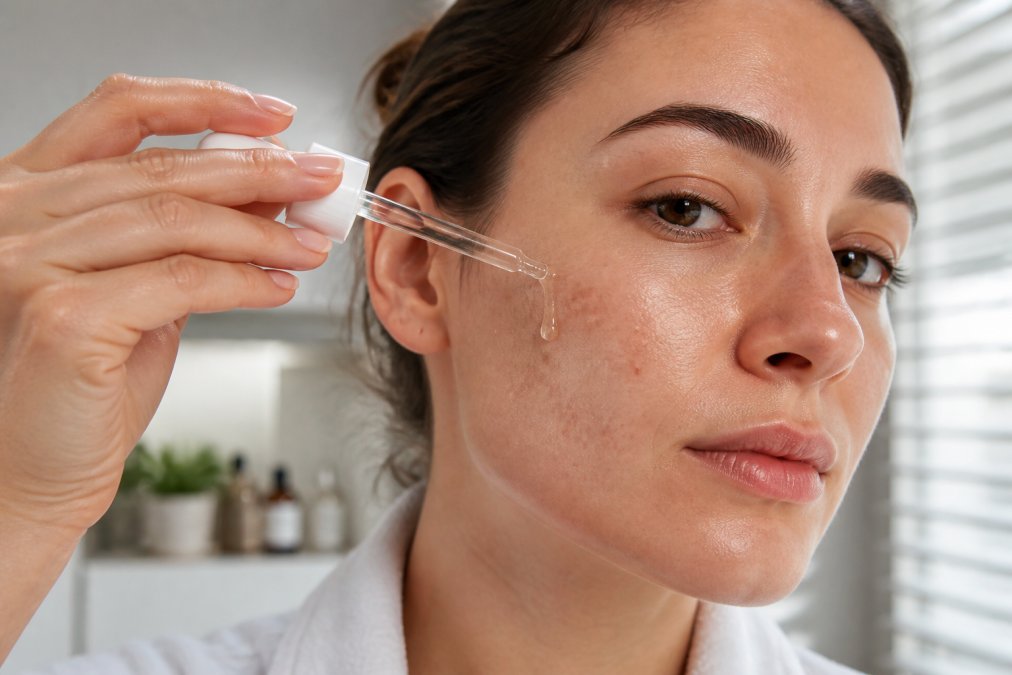
The choice depends on the skin type and how sensitive it is. Here is what to expect from each group, with specific concentrations and timeframes.
Vitamin C for brightening and antioxidant protection
Vitamin C is one of the most well-researched antioxidants in dermatological care. It neutralizes free radicals and reduces the activity of tyrosinase, the enzyme that lies at the core of melanin production.
Concentration: Effective formulas typically contain 10-20% L-ascorbic acid. Lower percentages act more gently but more slowly; higher percentages over 20% offer no additional benefit and may cause irritation.
Time to results: With regular use, most people notice a more even skin tone after 8-12 weeks. Results are not instantaneous.
Form and stability: L-ascorbic acid is unstable and oxidizes upon contact with light and air. More stable derivatives like ascorbyl glucoside and sodium ascorbyl phosphate act more gently but are better suited for sensitive skin.
The ingredient is photo-modulating, so it is sensible to combine it with sun protection rather than replacing it.
Azelaic acid and benefits for sensitive skin
Azelaic acid is one of the few active ingredients that simultaneously brightens and calms. It is suitable for skin with rosacea, a tendency to redness, or post-inflammatory spots.
Concentration: Dermatological formulas typically contain 10-20%. For beginners, 10% is sufficient.
Mechanism: It inhibits tyrosinase and reduces melanin production while also acting as an anti-inflammatory and antibacterial agent, which is why it is useful for acne and rosacea.
Retinoids, hydroquinone, arbutin, and kojic acid: when to use them
Retinoids accelerate cell turnover and fade pigment by pushing colored cells to the surface. Start with retinol 0.3% twice a week and gradually increase the frequency. Results are usually seen after 12-16 weeks.
Peel Shot Peeling Ampoule with White Rice →
| Ingredient | Mechanism | Concentration | Time to result | Best suited for |
|---|---|---|---|---|
| Vitamin C | Antioxidant, inhibits tyrosinase | 10-20% | 8-12 weeks | Thin skin, prevention |
| Azelaic acid | Brightens and calms | 10-20% | 6-8 weeks | Sensitive skin, rosacea |
| Retinoid | Accelerates renewal | 0.3-1% | 12-16 weeks | Resilient skin, old spots |
| Hydroquinone | Directly blocks melanin | 2-4% | 4-8 weeks | Stubborn melasma (with doctor) |
| Arbutin / kojic acid | Mild inhibition of tyrosinase | 1-2% | 8-12 weeks | Long-term maintenance |
How to choose an ingredient based on your skin type
- Sensitive skin: azelaic acid, niacinamide, arbutin
- Oily and acne-prone: azelaic acid, niacinamide, salicylic acid
- Dry and thin: vitamin C, niacinamide, arbutin
- Resilient, with stubborn spots: retinoid, hydroquinone (under medical supervision)
Niacinamide for spots: how it works and how to include it in your routine
Niacinamide reduces the transfer of melanin from melanocytes to surface cells. This means the spots do not disappear instantly, but they stop deepening while existing ones gradually fade.
Korean cosmetics for pigmentation: why the formulas are gentler
Korean pigmentation cosmetics rely on multi-layered yet low-concentration formulas. Instead of a single aggressive agent, they combine several mild ingredients that work together.
Sun protection for hyperpigmentation: why SPF is mandatory
Without sun protection, any hyperpigmentation treatment is pointless. UV rays activate melanocytes again and reverse the results, often in a matter of days.
Removing dark spots on the face: combining ingredients and protocols
Removing dark spots on the face requires a combination of ingredients, not a single product. The order of application determines how much of the active substances actually reach the skin. Most articles list ingredients but omit two critical questions: which of them should not be mixed and in what sequence to introduce them over time.
Which ingredients should not be combined in one application
Some active substances interfere with each other or increase the risk of irritation when applied together:
- Retinoids and Vitamin C work at different pH levels. Vitamin C is effective in an acidic environment, while retinoids work at a more neutral one. Mixed, both lose part of their activity, and the risk of redness increases. Separate them: vitamin C in the morning, retinoids in the evening.
- Retinoids and AHA/BHA acids (glycolic, lactic, salicylic): combined exfoliation thins the barrier and can trigger inflammation, which only deepens the spots. Use them on different evenings.
- Benzoyl peroxide and retinoids: benzoyl peroxide oxidizes the retinoid and reduces its effect. If both are necessary, apply them at different times of the day.
- Vitamin C and niacinamide: the old belief that they interfere with each other is outdated. Modern formulas are well-tolerated together, but for sensitive skin, it is sensible to apply them with a short pause in between.
Work sequence for morning and evening
The order of application follows the principle of "thinnest to thickest" and "lowest to highest pH":
Morning routine:
- Cleanse your face with a mild product
- Apply an antioxidant (Vitamin C) on dry skin
- Wait two minutes and add niacinamide
- Apply a moisturizer for barrier support
- Finish with SPF 50 sun protection
Evening routine:
- Cleanse your face
- Apply a retinoid on dry skin (if skin is sensitive, apply over a moisturizer)
- Wait and apply a restorative cream
Three-month protocol for treating spots
Pigmentation forms over months and fades even more slowly. A structured plan helps ensure you don't give up just when results start to become visible.
- Weeks 1-2 (introduction): Only sun protection and hydration. The goal is for the barrier to be stable before adding active ingredients.
- Weeks 3-4 (first active): Introduce 2-5% niacinamide in the morning. Monitor your skin's reaction.
- Weeks 5-8 (second active): Add Vitamin C in the morning or azelaic acid in the evening, depending on sensitivity.
- Weeks 9-12 (retinoid): Introduce a retinoid in the evening, two to three times a week, and gradually increase the frequency.
Fitzpatrick Skin Phototypes: Why They Matter
The Fitzpatrick scale classifies skin based on its reaction to UV rays, from Type I (very fair, burns easily) to Type VI (very dark, rarely burns). The darker the phototype, the more active the melanocytes, and the easier it is to develop post-inflammatory hyperpigmentation.
Sample Routine with Bellaskin Products
Bellaskin offers products formulated around niacinamide and allantoin, which soothe the skin and help even out skin tone. The Korean formula with calendula and astragalus extracts provides antioxidant protection.
Common Mistakes and How to Avoid Them
The most common mistake is expecting quick results. Pigmentation forms over months and fades even more slowly. People often stop treatment just as it begins to work.
Conclusion
Pigmentation does not disappear with a single product. It requires the right combination of ingredients, patience, and daily sun protection.
Frequently Asked Questions
What are the most effective ingredients for removing dark spots?
The best ingredients against dark spots include niacinamide, Vitamin C, azelaic acid, retinoids, and arbutin. Niacinamide reduces melanin transfer, Vitamin C blocks tyrosinase and acts as an antioxidant, and azelaic acid is suitable for sensitive skin. Visible results require 8-12 weeks of consistent use and mandatory sun protection.
Can niacinamide help with brown spots?
Yes, niacinamide is among the most well-researched ingredients for brown spots. It reduces the transfer of melanin from melanocytes to keratinocytes, which gradually lightens the spots. It is typically used in a 4-5% concentration and is suitable for sensitive skin. Noticeable effects are seen after 8-12 weeks. Combine with Vitamin C and SPF for faster results.
Should I use sun protection when treating spots?
It is absolutely mandatory. UV rays stimulate melanocytes, and without SPF, all lightening ingredients are pointless. Use SPF 50 every day, even on cloudy days, and reapply every 2 hours when exposed to the sun. Sun protection in cases of hyperpigmentation is key to preventing new spots and photoaging.
Are brightening ingredients safe for sensitive skin?
Many of them are safe, but they require caution. Niacinamide, azelaic acid, and arbutin are among the gentlest. Retinoids and hydroquinone can be irritating, so start with a low concentration and apply every other day. Always patch test on a small area and avoid combining several active ingredients at once. If the skin becomes red, reduce the frequency.