


Table of Contents
- What changes in the skin after 30
- Korean facial cosmetics: why it works after 30
- Niacinamide skin benefits: even complexion and healthy barrier
- Daily facial routine: step by step
- Facial peeling ampoules: gentle exfoliation without redness
- Active ingredients and eye contour care
- Minimalist routine and budget planning for cosmetics
- Conclusion: sustainable skincare after 30
- Frequently asked questions
Last update: October 3, 2026
What changes in the skin after 30
Skincare after 30 requires a different strategy than the one you followed in your twenties. After 30, collagen production decreases by about 1% per year, and the first fine lines appear where the skin is thinnest: around the eyes and mouth. This guide from Bellaskin explains exactly what happens to the dermis and how to build a routine that works with these changes instead of against them.
Your skin does not change suddenly. The change is gradual, which is why most women only notice it when their makeup starts to sit differently or when evening light reveals shadows that weren't there before.
Collagen, elastin, and the first fine lines
Collagen is the structural protein that gives skin firmness, and elastin is the fibrous protein that allows it to return to its original shape after movement. After 30, both processes slow down, and the lipid barrier retains less water.
The result is visible in the mirror:
- Expression lines around the eyes and forehead become visible even at rest
- The skin looks duller and less radiant
- Pores around the nose and cheeks are more clearly visible
- Hydration decreases, which highlights every dry area
This is where most routines fail. People add stronger products instead of repairing the barrier. If the epidermis does not retain water, no active serum will compensate for it.
Stress and the psychological aspect of aging
Chronic stress raises cortisol levels, and cortisol accelerates the breakdown of collagen and intensifies inflammatory processes in the skin. This is the aspect that almost all guides skip because it cannot be sold in packaging.
The practical conclusion is inconvenient: if you sleep five hours, drink little water, and live in constant deadlines, the most expensive serum on the market will yield a weaker result than an average product on a woman who sleeps eight hours. Include sleep and water in your care budget, not just creams.
Korean facial cosmetics: why it works after 30
Korean facial cosmetics follow a logic of layering and prevention, rather than single "miracle" products. Instead of one powerful cream, it applies several light products sequentially, with each preparing the skin for the next. For skin after 30, this means better hydration without heaviness and less irritation.
The formulas often rely on plant extracts and soothing ingredients. Our products, for example, combine marigold and astragalus extracts with niacinamide and allantoin to strengthen the skin's natural defense while working on tone and texture.
Niacinamide skin benefits: even complexion and healthy barrier
Niacinamide skin benefits are due to the fact that vitamin B3 works on two fronts simultaneously: it regulates sebum production and strengthens the lipid barrier. For a woman 30+ with enlarged pores and dark acne spots, this is a rare combination because most active ingredients only deal with one.
What to expect in real use:
- Less visible pores after a few weeks of regular application
- A more even complexion, without a bleaching effect
- Less redness in sensitive skin
- Better hydration retention from subsequent products
Daily facial routine: step by step
A daily facial routine after 30 shouldn't be long, but consistent. Five to six products used every night yield more than ten products applied from time to time. But the same routine doesn't work the same for everyone; the skin type determines which steps to keep and which to remove.
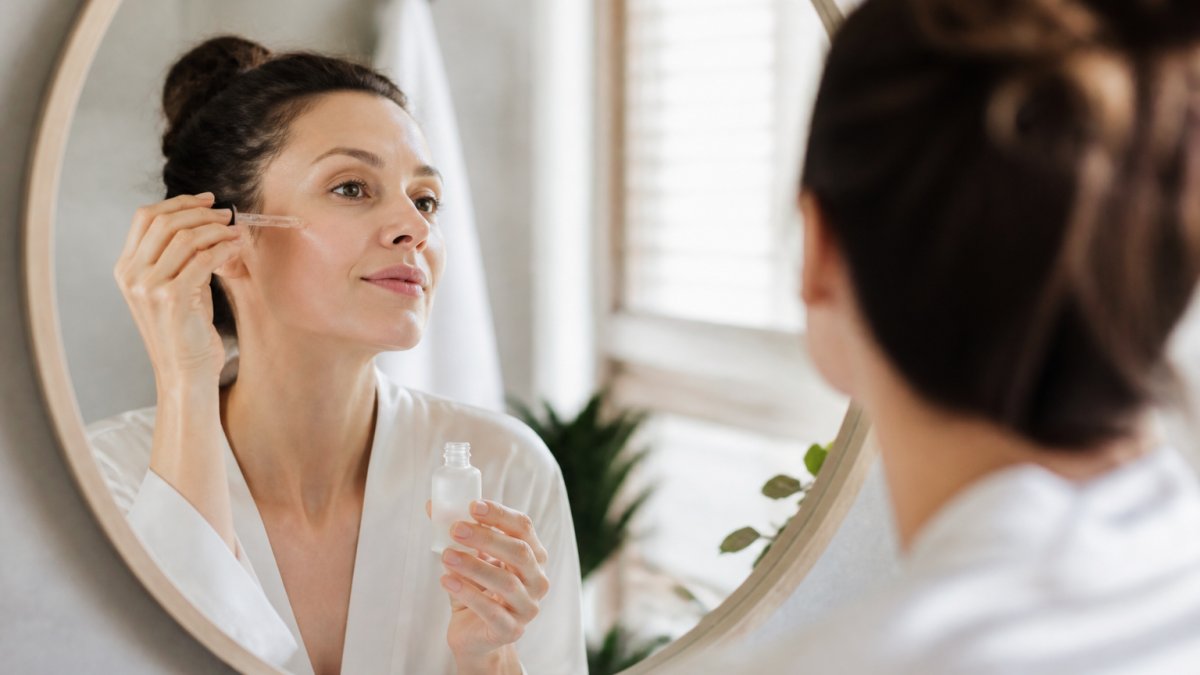
The universal base that applies to every skin type
- Cleanse with a gentle product that does not leave a feeling of tightness
- Apply an alcohol-free toner to restore pH balance
- Add a serum with hyaluronic acid or niacinamide
- Seal with a moisturizer on slightly damp skin
- In the evening, swap the cream for a richer night product
These five steps are the skeleton. The difference comes in the texture of the products and how many layers your skin can actually handle.
Personalized routine according to skin type
Oily skin after 30. The problem here is not excess sebum, but the combination of shine in the T-zone and enlarged pores. Choose a gel cleanser with niacinamide, a light hydrating liquid instead of cream, and a serum with niacinamide or salicylic acid. Avoid heavy oils; they clog pores and accentuate shine. Choose SPF in the form of a fluid or gel.
Dry skin after 30. The lipid barrier is weakened, and the skin loses water faster. Choose a cream cleanser that doesn't foam, a toner with glycerin or panthenol, and a serum with hyaluronic acid on slightly damp skin. Seal with a cream containing ceramides or squalane. In the evening, add a facial oil as a final step if the skin remains tight.
Combination skin after 30. The most common type after 30. Apply lighter textures in the T-zone and richer ones on the cheeks. Multi-masking—a clay mask only on the T-zone and a hydrating one only on the cheeks once a week—solves the problem without needing two separate sets of products.
Sensitive skin after 30. The barrier is reactive and responds to active ingredients. Introduce one new product every two weeks, not all at once. Avoid using retinol and acids simultaneously. Look for formulas with Centella Asiatica, allantoin, and panthenol.
Sun protection (SPF) as prevention against photoaging
SPF is the most important step in an anti-aging routine because UV rays cause most visible aging. The sun breaks down collagen, creates free radicals, and deepens the dark spots you've just been working on.
Apply SPF 30 or higher every day, including during winter and on cloudy days. If you use retinol at night, morning sun protection is not an option, but a mandatory condition for the active ingredient to work safely. For oily skin, choose a fluid; for dry, a cream; for combination, a light emulsion. This is the only step where you shouldn't worry about the budget.
Facial peeling ampoules: gentle exfoliation without redness
Facial peeling ampoules are concentrated exfoliation formulas that remove dead cells from the surface of the epidermis and accelerate cell regeneration. Unlike aggressive scrubs, ampoules usually work with enzymes or mild acids and do not leave micro-tears.
Peel Shot White Rice Peeling Ampoule →
Here we recommend our Peel Shot White Rice Peeling Ampoule. The formula is designed for complete exfoliation without redness; it removes blackheads, tightens, and unclogs pores, while simultaneously providing deep and nourishing hydration.

Active ingredients and eye contour care
Active ingredients are what actually change the skin after 30, but only if they are introduced correctly. Most women's mistake is not in the choice of product, but in the order of application and in combining ingredients that interfere with each other.
Retinol, vitamin C, and antioxidant protection
Vitamin C. Acts in the morning as antioxidant protection against free radicals and supports collagen synthesis. Effective forms are L-ascorbic acid (stronger, but more irritating) and derivatives such as ascorbyl glucoside or sodium ascorbyl phosphate (milder, suitable for sensitive skin). Apply in the morning after cleansing and before SPF. If the formula darkens in the bottle, it has oxidized and lost activity.
Rotation. Do not combine retinol and vitamin C in the same morning or evening. The classic schedule is: vitamin C in the morning, retinol in the evening. If the skin is sensitive, alternate the nights: retinol on Monday, Wednesday, and Friday, and on other nights, only hydration.
Caffeine and Centella Asiatica. Caffeine in eye products reduces puffiness by constricting blood vessels, and Centella Asiatica soothes irritated skin and supports barrier repair.
Eye contour care
Eye cream is a product that deserves a separate budget after 30. The skin around the eyes is the thinnest on the face and has no sebaceous glands to protect it. That is why it shows the first signs of fatigue and aging.
Apply eye cream with your ring finger—it exerts the least pressure—using light tapping motions along the orbital bone, not on the eye itself. The morning product may contain caffeine or vitamin C; the evening one, retinol in a low concentration or peptides.
Minimalist routine and budget planning for cosmetics
Skinimalism, or a minimalist routine, is not a rejection of care. It is a strategy for choosing fewer products with a higher concentration of active ingredients. For skin after 30, it often yields better results than a long routine because it reduces the risk of irritation and facilitates regular compliance.
| Priority | Product | Why it is important | Estimated budget |
|---|---|---|---|
| 1 | Cleansing product | Removes impurities without damaging the barrier | Low |
| 2 | SPF | Prevention against photoaging | Medium |
| 3 | Niacinamide serum | Tone and pores | Medium |
| 4 | Night cream | Restoration and hydration | Medium |
| 5 | Peeling ampoule | Weekly exfoliation | 29.99 BGN |
| 6 | Eye cream | Thin area without oil glands | Medium |
If your budget is limited, start with the first three rows. The peeling ampoule and eye cream should be added once the base routine is already being followed regularly.
Conclusion: sustainable skincare after 30
Skincare after 30 is not a matter of more expensive products, but of proper consistency and patience. Most women see the first real changes in tone and texture after a few weeks of consistency, not after a single application.
If you are looking for gentle exfoliation without redness that unclogs pores and smooths the skin, take a look at the Peel Shot White Rice Peeling Ampoule at Bellaskin. The white rice formula provides deep hydration and comprehensive exfoliation. Buy now and start with one step that your skin will feel from the very first application.
Frequently asked questions
What are the most important steps in skincare after 30?
The foundation is a consistent daily routine: gentle cleansing, toner, a serum with active ingredients like niacinamide or vitamin C, a moisturizing cream, and SPF sun protection every morning. In the evening, add makeup removal and night care. This skincare after 30 maintains the lipid barrier and hydration, and protects against photoaging.
Which ingredients are mandatory in cosmetics after the age of 30?
Look for niacinamide to even out skin tone and strengthen the barrier, vitamin C and other antioxidants against free radicals, hyaluronic acid for hydration, retinol for cellular regeneration, and SPF for UV ray prevention. These ingredients cover the skin's needs after 30 and reduce the visibility of fine lines.
How does Korean cosmetics help maintain skin after 30?
Korean facial cosmetics emphasize multi-layered hydration, gentle formulas, and ingredients like centella asiatica, caffeine, and plant extracts. This approach supports elasticity, soothes redness, and maintains a radiant complexion. Many Korean formulas are aimed at prevention, making them suitable for anti-aging care after 30.
How often should you peel your face after 30?
For most skin types, it is sufficient to exfoliate once or twice a week. If you use facial peeling ampoules with a gentle formula, you can include them in the evening after cleansing, followed by a moisturizing cream. Over-exfoliation damages the lipid barrier, so observe your skin's reaction and adjust the frequency accordingly.
How to deal with the first fine lines after 30?
Focus on hydration, retinol, and antioxidant protection. Retinol supports cellular regeneration and the smoothing of fine lines, while hyaluronic acid retains water in the epidermis. Do not skip SPF, because UV rays accelerate photoaging. Combine these active ingredients with a regular but gentle skincare routine.
Why is hydration key for skin after 30?
After 30, collagen and elastin production decreases, and the lipid barrier retains less water. Hydration maintains elasticity, reduces the feeling of tightness, and makes fine lines less visible. Serums with hyaluronic acid and nourishing creams restore moisture and support a radiant complexion.
Can one product handle both dark spots and imperfections?
Yes, multifunctional formulas with niacinamide and allantoin work simultaneously on dark spots, redness, and texture. Niacinamide lightens pigmentation and regulates sebum, while allantoin soothes. For best results, combine such a product with regular exfoliation and SPF so that the spots do not return.
How should I plan my cosmetics budget after 30?
Invest primarily in three products: a serum with active ingredients, a high-quality cream, and sun protection. The remaining steps can be more affordable. A minimalist routine with 4-5 products often yields better results than a long routine with overlapping ingredients. Peeling ampoules are an economical solution because they cover exfoliation and hydration in one.