


Table of Contents
- What is porcelain skin and the Korean routine
- 10-step Korean routine for achieving a porcelain complexion
- Niacinamide benefits for the skin and evening out the complexion
- Removing pigment spots with Korean ingredients
- Face hydration: the key to radiant skin
- Layering mistakes and how to avoid them
- Conclusion: Your path to porcelain skin
- Frequently asked questions
Last update: September 17, 2026
What is porcelain skin and the Korean routine
Porcelain skin is a condition of an even tone, fine texture, and natural glow, where the skin reflects light evenly without visible spots or irritation. This is not a color, but the result of consistent care. Korean cosmetics for porcelain skin are built on multi-layered hydration, gentle exfoliation, and constant SPF protection, rather than one miracle product.
In this article, we will gather the steps, ingredients, and mistakes that actually affect the complexion. You will also see how to arrange your products so that each layer works instead of blocking the others.
The difference between porcelain and glass skin
Glass skin is about radiance: a damp, shiny surface that reflects light like glass. Porcelain skin is about uniformity: a matte-satin finish, tightened pores, and an even tone.
The former seeks shine, while the latter seeks clarity of complexion. Therefore, a porcelain complexion routine emphasizes niacinamide, antioxidants, and barrier care, whereas a glass skin routine emphasizes layering hydration.
10-step Korean routine for achieving a porcelain complexion
The classic 10-step Korean routine arranges products from the thinnest to the thickest consistency so they absorb sequentially. Here is the order that most practitioners follow:
- Cleansing oil to dissolve makeup and sunscreen
- Foam or gel cleanser to wash away water-soluble impurities
- Exfoliation with a gentle acid or enzyme formula, two to three times a week
- Toner to restore pH after cleansing
- Essence for initial hydration
- Serum with an active ingredient according to the issue
- Sheet mask for intensive nourishment
- Eye cream
- Moisturizer to lock in moisture
- SPF protection every morning
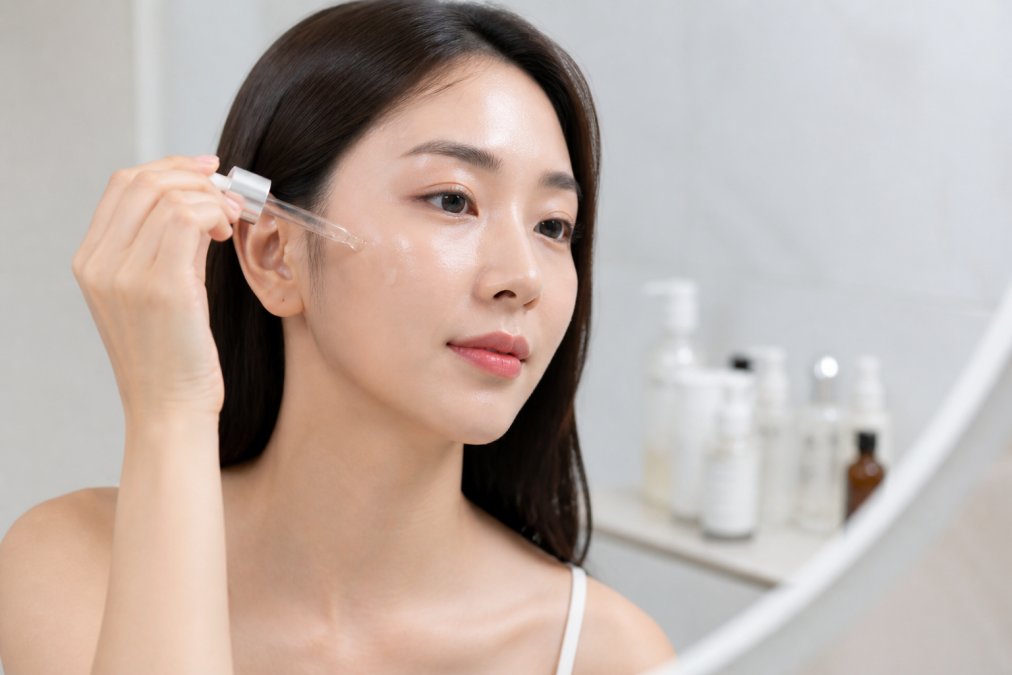
Double cleansing: the first and most important step
Double cleansing is the practice of removing oil-soluble impurities first, followed by water-soluble ones. Skipping the first step leaves SPF and sebum on the skin, which clogs pores and makes every subsequent product less effective.
The most common mistake is a cleanser that is too harsh. If the skin feels tight after washing, the barrier is already irritated, and the next layers will cause redness.
Niacinamide benefits for the skin and evening out the complexion
Niacinamide is a form of vitamin B3 that helps even out the complexion and strengthen the protective barrier (pubmed.ncbi.nlm.nih.gov). It works on the visibility of dark spots and sebum production, making it suitable for both oily and dry skin.
According to the American Academy of Dermatology, niacinamide is well-tolerated by most skin types and combines successfully with sun protection. The combination makes sense: SPF stops new spots, and niacinamide brightens existing ones.
Removing pigment spots with Korean ingredients
Pigment spots do not disappear with a single product because melanin is produced in a chain, not in one place. Understanding this chain explains why Korean formulas combine several active ingredients instead of relying on just one.
How melanin is formed, and where the ingredients come in
Melanin is synthesized in melanocytes via the enzyme tyrosinase. When tyrosinase is active, it converts the amino acid tyrosine into dopa, then into dopaquinone, a precursor to melanin. UV radiation, hormonal fluctuations, and inflammation (e.g., after acne) amplify this process.
Different ingredients act at different stages of this chain:
- Vitamin C (L-ascorbic acid and its derivatives), inhibits tyrosinase and neutralizes free radicals generated by UV radiation. It is unstable in aqueous formulas, so Korean products often use derivatives like ascorbyl glucoside or magnesium ascorbyl phosphate.
- Niacinamide, blocks the transfer of melanin from melanocytes to keratinocytes (pigment "granules" do not reach the surface), rather than destroying already formed melanin. Therefore, results are visible after 4-8 weeks of regular use.
- Fermented extracts (galactomyces, rice ferment, soy ferment), are not bleaching agents in a strict sense; they support the barrier and microbiome, which reduces the inflammatory signal that otherwise sustains hyperpigmentation.
- Alpha-arbutin and kojic acid, competitive tyrosinase inhibitors, often found in Korean brightening serums.
Practical sequence
Morning: Vitamin C serum → niacinamide → SPF. Evening: alternate niacinamide with arbutin or kojic acid, but do not apply Vitamin C and a strong acid in the same layer; their pH levels differ, and both lose effectiveness.
How long it takes
Pigment is located in different layers of the epidermis. Surface spots (post-acne, mild sunburn) react in 4-6 weeks. Deep ones (melasma, hormonal) require 3-6 months and often dermatological intervention. No cream works in days, and if a product promises that, the formula likely contains bleaching agents that are not suitable for long-term use.
Peel Shot White Rice Peeling Ampoule →
Face hydration: the key to radiant skin
Hydration and moisturizing are not the same thing, and the confusion between them is the number one reason for "dry but oily" skin. Hydration adds water; moisturizing retains water. A porcelain complexion requires both, in the right order.
Mechanism: trans-epidermal water loss
The skin loses water continuously through the epidermis, a process called trans-epidermal water loss (TEWL). When the barrier is healthy, lipids between cells (ceramides, cholesterol, fatty acids) form a "cement" that limits loss. When it is damaged by aggressive cleansing, excessive exfoliation, or cold, water escapes faster, and the skin looks dull because the uneven surface scatters light.
Therefore, hydrating ingredients are divided into three groups:
- Humectants (glycerin, hyaluronic acid, betaine, panthenol), attract water from the environment and from deeper layers. Low molecular weight hyaluronic acid penetrates deeper, but in very dry air, it can pull water from the skin, so it should always be sealed with a cream.
- Emollients (squalane, oils, esters), fill the microscopic gaps between cells and make the surface smooth.
- Occlusives (petroleum jelly, lanolin, waxes), form a film that stops evaporation. They are the strongest, but can clog pores on oily skin.
Personalizing by skin type
- Dry skin: essence → hyaluronic acid serum → ceramide cream → thin layer of occlusive at night. Avoid alcohol in toners.
- Oily skin: light essence → niacinamide serum (controls sebum) → oil-free gel cream. Occlusives are unnecessary and can cause comedones.
- Combination skin: multi-molecular hyaluronic acid on the entire face, richer cream only on the cheeks.
- Mature skin: hydration decreases with age because sebum and ceramide production drops. Combine humectants with peptides and antioxidants.
Layers and sealing
The order is from thinnest to thickest: essence → serum → cream. If you apply the cream before the serum, the thick layer blocks the active ingredient, and it remains on the surface. A product like Bellaskin Collagen Jelly suits the step after the essence because it retains moisture and supports elasticity without weighing the skin down.

The Mayo Clinic for skincare confirms that well-hydrated skin retains its natural defense against external irritants better.
Layering mistakes and how to avoid them
Layering is confused most often for two reasons: the wrong order and too many active ingredients at once. Both lead to reduced effectiveness and an irritated barrier.
| Mistake | What happens | How to fix it |
|---|---|---|
| Cream before serum | Thick layer blocks the active ingredient | Rearrange from thin to thick |
| Two exfoliants in one day | Barrier is damaged and redness appears | Exfoliate two to three times a week |
| Skipped SPF | New spots appear while old ones fade | Apply SPF every morning |
| Too many active ingredients | Skin becomes irritated and looks worse | Introduce one new ingredient at a time |
Conclusion: Your path to porcelain skin
Consistency beats intensity. Korean cosmetics for porcelain skin work when you arrange your products correctly and don't change everything at once. Start with double cleansing, add niacinamide, and keep up with SPF every morning.
Frequently asked questions
What is the porcelain skin effect?
Porcelain skin is the result of the Korean beauty routine, where the complexion becomes even, smooth, and radiant, without visible pores or blemishes. It is achieved through multi-step care with double cleansing, essences, serums containing niacinamide and hyaluronic acid, as well as regular SPF protection. The key lies in consistency and persistence, rather than a single product.
What are the main steps in the Korean facial routine?
The Korean routine includes 10 steps: double cleansing, exfoliation, toner, essence, serum, sheet mask, eye cream, moisturizer, SPF, and sleeping mask. Each step prepares the skin for the next, with hydration and the protective barrier being the priority. For beginners, it is enough to start with 5-6 steps and add more gradually.
Which ingredients in Korean cosmetics help brighten the complexion?
Niacinamide, Vitamin C, fermented ingredients, and white rice extracts are among the most effective for evening out skin tone and removing dark spots. Niacinamide reduces melanin production and strengthens the protective barrier. Combine these ingredients with regular SPF protection to prevent new spots from appearing.
How long does it take to see visible results with Korean cosmetics?
The first visible improvements in hydration and radiance can be noticed within 24 hours of the first application. To even out skin tone and reduce dark spots, 4-8 weeks of regular use are needed. Results depend on skin type and consistency. It is recommended to take a photo of your skin once a week to track progress.
Is Korean cosmetics suitable for sensitive skin?
Yes, many Korean formulas are created specifically for sensitive skin, containing allantoin, marigold, and astragalus extracts that soothe redness. Avoid aggressive exfoliants and alcohol. Always test a new product on a small area behind the ear for 24 hours. If you experience severe irritation, consult a dermatologist.
How do we choose the right products according to skin type?
For dry skin, choose richer creams with hyaluronic acid and collagen. For oily skin, rely on light gels and serums with niacinamide. For combination skin, combine light textures with targeted nourishment. For sensitive skin, avoid fragrances and alcohol. Always introduce one new product every 2 weeks to see how your skin reacts.