


Contents
- What are facial peeling ampoules and how do they work?
- Types of peeling ampoules: enzymatic, acid, and mechanical peeling
- Enzymatic facial peeling: benefits and who it is best suited for
- How to use facial ampoules: step-by-step
- Korean facial cosmetics: why peeling ampoules are the foundation of a routine
- Skin hydration after peeling: how to restore the barrier
- Contraindications, risks, and combining with other active ingredients
- Which peeling ampoule is best for your skin type: comparison and prices
- Frequently asked questions
Last updated: September 16, 2026
What are facial peeling ampoules and how do they work?
Facial peeling ampoules are concentrated, single-dose formulas with exfoliating ingredients that break down dead skin cells and accelerate epidermal renewal. Unlike classic exfoliants, they contain a higher concentration of active substances in a small volume and target skin texture specifically.
The demand for the best facial peeling ampoules is growing because more and more women are looking for quick results without a lengthy routine. In this Bellaskin guide, we will examine how these formulas work, what the active ingredients are, and how to choose the right one for your skin type.
A peeling ampoule is a concentrated, single-use formula that applies exfoliating active ingredients directly to the skin to accelerate cell renewal and smooth texture. It is not just a stronger exfoliant, but an intensive therapy with a short course.
The difference between an ampoule and a classic exfoliant
A classic exfoliant works on the surface and is used regularly as part of a routine. A peeling ampoule is a short, intensive course: you apply it for a few minutes, wash it off, and get a visible result the same day.
If you are looking for gradual smoothing, choose a mild exfoliant. If you want quick revitalization before an event or during a plateau in your routine, an ampoule is more suitable.
Types of peeling ampoules: enzymatic, acid, and mechanical peeling
The three main types of peeling ampoules differ in how they remove dead cells: enzymatic degrades proteins, acid dissolves the bonds between cells, and mechanical acts through physical action. Each has a different safety profile and requires a different approach.
Enzymatic peeling uses proteolytic enzymes, most commonly papain (from papaya), bromelain (from pineapple), or ficin (from fig). They break down the keratin that binds dead cells together without damaging living ones. Enzymatic peeling works at a pH of around 4-6 and is the gentlest option; it rarely causes redness and is suitable for sensitive skin.
Acid peeling relies on AHA, BHA, or PHA acids. It is more active and requires attention to concentration and pH balance. The optimal efficacy of AHA acids is at a pH between 3 and 4; at a higher pH, the acid does not penetrate enough, and at a lower one, it can cause burns. Therefore, with acid ampoules, it is especially important to follow the indicated application time and not exceed the frequency.
Mechanical peeling contains fine particles (e.g., zeolite, rice powder, or sugar crystals) that physically remove dead cells. It is suitable for normal skin, but not for sensitive or irritated skin, as friction can damage the skin barrier and cause micro-injuries.
AHA, BHA, and PHA acids: which type is suitable for your skin?
- AHA acids (glycolic, lactic, mandelic) work on the surface and even out skin tone. Glycolic acid has the smallest molecule and penetrates deepest; lactic acid is gentler and hydrating. Suitable for dry and normal skin.
- BHA acids (salicylic) are oil-soluble and penetrate pores, where they dissolve sebum. Best for oily skin and blackheads.
- PHA acids (gluconolactone, lactobionic) have larger molecules and act most gently while simultaneously attracting moisture. The choice for sensitive skin.
Lactic acid is often preferred because it combines exfoliation with hydration. It has a keratolytic effect while retaining moisture, making it suitable for drier skin as well.
Contraindications and risks of peeling ampoules
Peeling ampoules are not suitable for everyone. Avoid them in cases of:
- Active acne with inflammation and pustules
- Open wounds, abrasions, or recent hair removal (wait at least 48 hours)
- Sunburn or red, irritated skin
- Recent dermatological procedure (laser, microdermabrasion) – wait the time specified by the specialist
- Pregnancy and breastfeeding – consult a dermatologist before using acid formulas
When in doubt, always consult a dermatologist. If you feel intense burning, redness, or pain during application, wash off immediately with lukewarm water and apply a soothing cream.
Combining with other active ingredients
After a peeling ampoule, the skin is more susceptible, so combining it with other active ingredients requires caution:
Peel Shot White Rice Peeling Ampoule →

- Retinol: wait at least 48 hours after a peel.
- Vitamin C: avoid on the same day; the combination can cause severe irritation.
- Niacinamide and allantoin: they are safe and soothe the skin, a good choice for the days following a peel.
- Benzoyl peroxide: alternate on different days, never together.
- Hyaluronic acid and glycerin: suitable immediately after a peel to restore moisture.
Photosensitivity is a real risk. After every exfoliation, use high SPF sun protection, even on cloudy days, to prevent hyperpigmentation.
Enzymatic facial peeling: benefits and who it is best suited for
Enzymatic facial peeling is the gentlest way to renew the skin without disrupting the skin barrier. Benefits include smoothing the texture, reducing fine lines, and a more radiant complexion.
It is best suited for sensitive skin, for women with mild rosacea, and for anyone who wants exfoliation without the risk of redness. If your skin reacts to acids, an enzymatic formula is the sensible choice.
How to use facial ampoules: step-by-step
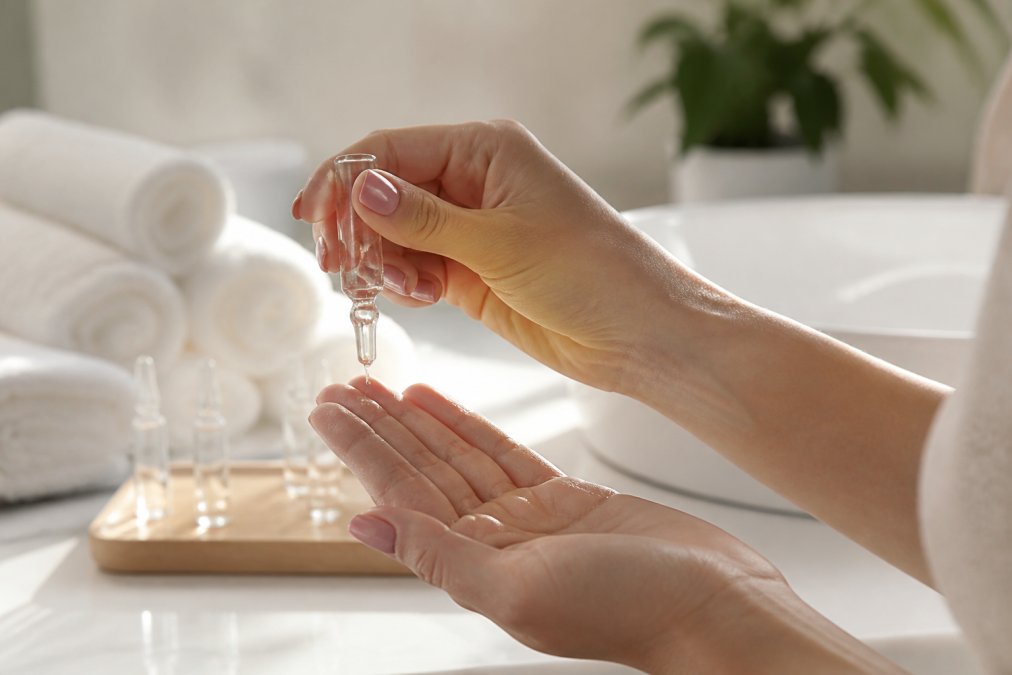
The proper use of facial ampoules takes under ten minutes and follows a clear sequence. Here is how the process looks.
- Cleanse your face with a gentle cleanser and pat dry.
- Open the ampoule and pour the contents into your palm.
- Apply evenly, avoiding the area around the eyes.
- Leave on according to the product instructions, usually a few minutes.
- Wash off with lukewarm water and apply a hydrating cream.
Application frequency according to skin type
| Skin Type | Frequency | Course Duration |
|---|---|---|
| Oily and combination | 1-2 times a week | 4 weeks |
| Normal | 1 time a week | 3-4 weeks |
| Dry | Once every 10 days | 3 weeks |
| Sensitive | Once every 2 weeks | 2-3 weeks |
Korean facial cosmetics: why peeling ampoules are the foundation of a routine
Korean facial cosmetics place exfoliation at the center of the routine because a smooth surface allows subsequent products to penetrate deeper. Peeling ampoules are the natural first step toward a radiant complexion.
Skin hydration after peeling: how to restore the barrier
Skin hydration after a peel is mandatory, not optional. Exfoliation temporarily weakens the skin barrier, and without moisture, the skin becomes tight and irritated.
Contraindications, risks, and combining with other active ingredients
Peeling ampoules are not suitable for everyone and should not be combined with everything. Following these restrictions protects the skin from long-term consequences.
- Retinol: wait at least 48 hours after a peel.
- Vitamin C: avoid on the same day.
- Niacinamide and allantoin: they are safe and soothe the skin.
- Benzoyl peroxide: alternate on different days.
Which peeling ampoule is best for your skin type: comparison and prices
The choice depends on three factors: skin type, desired result, and tolerance to active ingredients. Here is a practical comparison of the main options with approximate prices in BGN.
| Peel Type | Active Ingredients | Best Suited For | Approximate Price |
|---|---|---|---|
| Enzymatic | Papain, bromelain, ficin | Sensitive skin | 25-45 BGN |
| AHA | Glycolic, lactic, mandelic acid | Dry, dull skin | 20-40 BGN |
| BHA | Salicylic acid | Oily, acne-prone | 25-50 BGN |
| PHA | Gluconolactone, lactobionic acid | Very sensitive skin | 35-60 BGN |
| Combined | Enzymes + niacinamide | All types | 30-55 BGN |
How to choose based on skin type
- Oily and combination skin: BHA (salicylic acid) is the best choice because it penetrates the pores and dissolves sebum. A combined formula also works well.
- Dry skin: AHA with lactic acid, exfoliates and hydrates at the same time. Avoid high concentrations of glycolic acid.
- Normal skin: can use almost any type, but enzyme or combined are the safest for regular use.
- Sensitive skin: PHA or enzyme peel. Avoid BHA and high concentrations of AHA.
- Skin with hyperpigmentation: AHA with glycolic or mandelic acid, combined with niacinamide to lighten dark spots.
Long-term treatment plan
To avoid exhausting your skin barrier, work in cycles:
- Active phase (3-4 weeks): use a peeling ampoule according to the frequency for your skin type (see the table above).
- Recovery phase (2 weeks): stop peeling and focus on hydration and nourishment with creams without active acids.
- Maintenance phase: after recovery, you can start a new cycle or switch to a gentler exfoliant once a week.
Frequently asked questions
How do facial peeling ampoules work?
Peeling ampoules contain a concentrated formula with acids or enzymes that break down dead cells from the surface layer of the epidermis. This accelerates cell renewal, unclogs pores, and evens out skin texture. Unlike classic exfoliants, ampoules act deeper and often contain additional ingredients such as niacinamide and allantoin, which soothe and hydrate. The result is a more radiant complexion and reduced imperfections after the first few applications.
Are peeling ampoules suitable for sensitive skin?
Yes, but the choice of formula matters. For sensitive skin, we recommend enzyme peeling ampoules or those with PHA acids, which have larger molecules and act more gently on the surface. Avoid high concentrations of AHA and BHA at first. Test on a small area behind the ear before the first application. If you feel burning or redness, reduce the frequency or choose a product with added soothing ingredients like allantoin.
How often should peeling ampoules be used?
The frequency depends on skin type and the concentration of active ingredients. For normal and combination skin, 2-3 times a week is sufficient. For sensitive or dry skin, start once a week and observe the reaction. If you use stronger formulas with AHA or BHA, do not exceed 2 applications per week. Excessive exfoliation can damage the skin barrier and cause redness and photosensitivity.
Should sunscreen be used after a peeling ampoule?
Yes, absolutely. After exfoliation, the skin becomes more sensitive to UV rays because the top layer of the epidermis is weakened. Apply sunscreen with SPF 30 or higher every morning, even on cloudy days. Without sun protection, you risk hyperpigmentation and delaying the positive results of the peel. This is one of the most frequently neglected steps in post-peel care.