


Table of Contents
- What is collagen face jelly
- Key benefits of collagen jelly for the skin
- Benefits of niacinamide in cosmetics and its role in collagen jelly
- Effectiveness of allantoin for redness and sensitive skin
- How collagen works on the skin
- How to use collagen jelly: Step by step
- Who is collagen jelly suitable for and how to include it in your routine
- Conclusion
- Frequently Asked Questions
Last updated: September 5, 2026
What is collagen face jelly
Collagen face jelly is a lightweight, gel-like cosmetic product with a high concentration of hydrolyzed collagen that absorbs quickly and provides a refreshing sensation. Unlike heavy creams, this texture moisturizes the upper layers of the skin without weighing it down or leaving it greasy. The base of the formula consists precisely of collagen jelly with low-molecular-weight peptides that penetrate the epidermis more easily.
The product combines a Korean formula with extracts of marigold and astragalus, supplemented by niacinamide and allantoin. This makes it suitable for various skin types, including sensitive and redness-prone skin.
The main difference between collagen jelly and regular serums is its ability to retain moisture. The gelatinous structure acts as a thin film that maintains hydration for hours, which is especially valuable for people with dehydrated skin or those living in urban environments with air conditioning and polluted air.
Key benefits of collagen jelly for the skin
The benefits of collagen jelly cover several key aspects. Primarily, it supports the repair of the skin barrier, which is often damaged by harsh cleansers or excessive sun exposure. When the barrier is healthy, the skin retains more moisture and looks plumper.
Regular use leads to a visible improvement in texture, fine lines around the eyes and lips become less pronounced, and the complexion gains a radiant look. This is due to the stimulation of the skin's natural production of collagen and elastin.
Here are the most common benefits reported by users:
- Improvement in skin elasticity and firmness
- Smoothing of fine lines and prevention of new wrinkles
- Deep hydration without a greasy film feeling
- Evening out skin tone and reducing hyperpigmentation
- Soothing of irritations and redness
It is important to note that collagen in cosmetics acts locally. It does not replace the collagen the body produces but rather supports regeneration processes and protects existing fibers from degradation. According to studies from dermatological clinics on the topical application of collagen, low-molecular-weight peptides can stimulate fibroblasts to produce new collagen.
Benefits of niacinamide in cosmetics and its role in collagen jelly
The benefits of niacinamide in cosmetics are widely documented, and this is one of the reasons it is present in the formula. Niacinamide, also known as vitamin B3, supports cellular renewal and enhances the synthesis of ceramides, which make up the skin's lipid layer.
In combination with collagen, niacinamide works in two directions: it improves barrier function, which reduces moisture loss, and regulates sebum production, reducing the visibility of pores. This makes the product suitable for people with combination or oily skin as well.
The concentration of niacinamide is balanced to avoid causing irritation to sensitive skin. Combined with allantoin, which has soothing properties, it achieves nourishment without the risk of redness. Collagen jelly with niacinamide can be applied on its own or in combination with a light moisturizer.
Effectiveness of allantoin for redness and sensitive skin
The effectiveness of allantoin for redness is due to its soothing and regenerating properties. It supports the healing of micro-injuries on the skin and reduces feelings of tightness and discomfort, being particularly valuable for people with rosacea or those who react sensitively to weather changes.
Clinical observations show that allantoin soothes the skin, acting as a protective shield against external irritants. Unlike some corticosteroid creams, it can be used long-term without the risk of skin thinning.
In the context of collagen jelly, allantoin acts as a "soother," balancing potentially active ingredients and ensuring the product is suitable for even the most sensitive skin types.
According to a dermatological review of allantoin as an active ingredient, allantoin stimulates cell proliferation and accelerates the healing process. It also softens the stratum corneum, which facilitates the absorption of other active ingredients in the product.
How collagen works on the skin
The mechanism of how collagen acts on the skin is often misunderstood. Many people believe that topical application directly replaces lost collagen, but the reality is more nuanced.
Hydrolyzed collagen vs. collagen peptides: what is the difference
All collagen used in cosmetics undergoes a process of hydrolysis, the breaking down of large protein chains into smaller fragments. But not all fragments are equal. The final product may contain:
- Full hydrolyzed collagen, with a molecular weight over 3000 Da (daltons). These molecules are too large to penetrate the stratum corneum and remain on the surface, where they act primarily as a moisturizer and film-former.
- Collagen peptides with low molecular weight, under 1000 Da. These fragments are small enough to pass between corneocytes (cells of the stratum corneum) and reach the living layers of the epidermis.
The cosmetic industry often uses the terms interchangeably, but for product effectiveness, molecular size is decisive. Collagen jelly, which relies on low-molecular-weight peptides, has a significantly different mechanism of action than a product that simply contains "collagen" as a marketing ingredient without specifying hydrolysis.
What happens after peptides penetrate
Once peptides pass through the stratum corneum, they do not turn directly into new collagen. Instead, they act as signaling molecules. Fibroblasts, the cells in the dermis responsible for producing collagen and elastin, recognize these peptide fragments and interpret them as an indication that existing collagen is being degraded. This triggers a cascade of cellular processes leading to increased synthesis of new collagen.
This process is not instantaneous. The skin renewal cycle lasts approximately 28 days in young skin but slows down with age. This is why visible results from the topical application of collagen peptides require a minimum of 4 to 8 weeks of regular use.
Why the gel texture changes absorption
The product's texture directly influences how much of the active ingredients reach the target layers. The gel-like structure has two advantages over traditional creams:
- Higher water base: gels contain significantly less fat than creams, which allows water-soluble peptides to remain in a dissolved state and migrate more easily between cells.
- Faster drying and lower occlusion: the gel does not create a thick, greasy film that would prevent subsequent steps in the routine from penetrating. This makes it ideal for layering with other active ingredients.
Antioxidant protection as a second mechanism
Beyond directly stimulating fibroblasts, collagen in the skin is also degraded by enzymes called matrix metalloproteinases (MMPs), which are activated by UV radiation and inflammation. The antioxidants in the formula, such as vitamin E and marigold extracts, neutralize free radicals that would otherwise activate these enzymes. In this way, the product acts on two fronts: it stimulates the production of new collagen and protects existing fibers from premature degradation.
How to use collagen jelly: Step by step
Correct application is half the battle, but the other half is understanding how collagen jelly interacts with other products in your routine. Here is the full protocol.
Step 1: Cleansing - Start with a gentle face cleanse to remove dirt and sebum. The skin should be slightly damp, as this facilitates the absorption of active ingredients. Avoid harsh cleansers with sulfates that disrupt the acid mantle.
Step 2: Toning - If you use a toner, apply it and wait 30 seconds for the skin to absorb it. A toner with a pH around 5.5 restores the skin's natural pH after cleansing, which is important for the optimal functioning of the enzymes involved in the skin barrier.
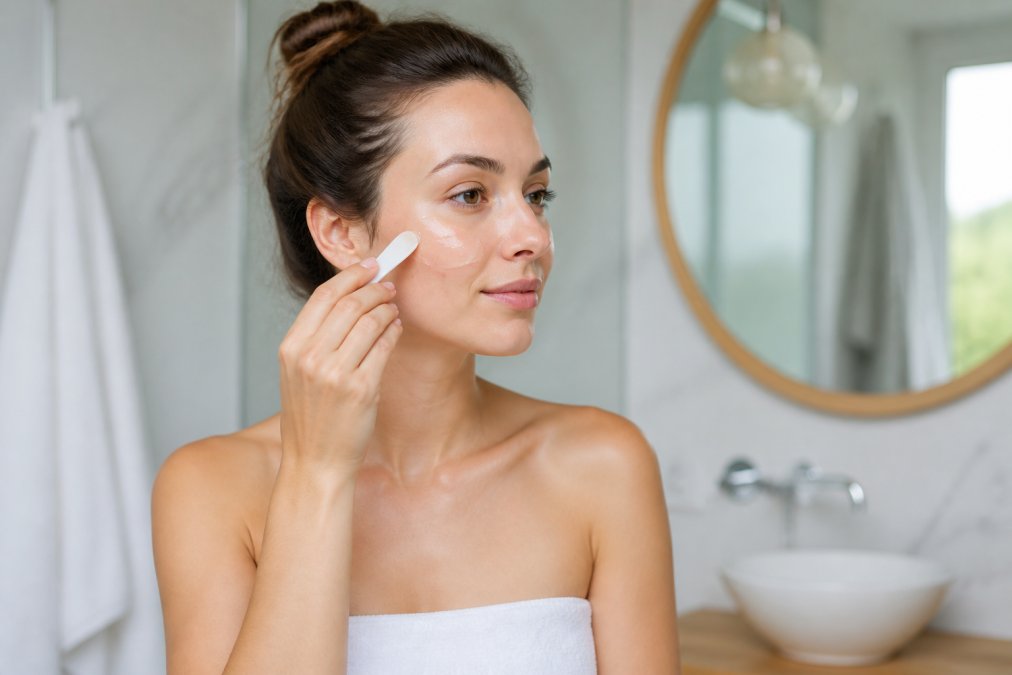
Step 3: Applying the collagen jelly - Take a pea-sized amount and spread it evenly with your fingertips. Use light patting motions instead of rubbing; patting stimulates microcirculation and reduces mechanical stress on collagen fibers.
Step 4: Sealing with a moisturizer - If your skin is very dry, apply a light moisturizer after the gel has absorbed. This "seals" in the hydration. For best results, wait 2–3 minutes after applying the gel to allow the water to absorb before adding the next layer.
Which ingredients collagen jelly works best with
Collagen peptides are surprisingly versatile, but certain combinations yield significantly better results:
- Vitamin C (L-ascorbic acid): This is perhaps the most valuable combination. Vitamin C is a cofactor for the hydroxylation of proline and lysine, two amino acids necessary for stabilizing the collagen triple helix. Apply a vitamin C serum in the morning, followed by collagen jelly; this way, the peptides receive the necessary building blocks.
- Hyaluronic acid: Hyaluronic acid attracts water to the intercellular space, which creates a better environment for the movement of collagen peptides. Apply a hyaluronic serum to damp skin, then the collagen jelly.
- Niacinamide: As described above, niacinamide strengthens the lipid barrier, which reduces transepidermal water loss and allows collagen peptides to remain in contact with the skin longer.
Which combinations to avoid
- Retinol at the start: Retinol accelerates cell renewal and can cause peeling during the first 2-4 weeks. If you combine retinol with collagen jelly, your skin will be doubly sensitive. The best approach: use retinol in the evening and collagen jelly in the morning. After 4-6 weeks, once the skin gets used to retinol, you can layer them; the collagen will help repair the barrier that retinol temporarily weakens.
- AHA/BHA acids simultaneously: Exfoliating acids dissolve the intercellular cement that holds corneocytes together. If you apply collagen jelly immediately after an acid exfoliant, the peptides will penetrate deeper, but this may lead to irritation. Wait at least 15-20 minutes after the acid before applying the gel.
- Heavy occlusive products (petroleum jelly, heavy oils): If you apply a thick, greasy layer immediately after the gel, you will block the absorption of the peptides. If you need occlusion, wait at least 10 minutes.
Morning and evening routine: specific examples
Morning routine (for antioxidant protection):
- Cleanse with water or a mild gel
- Vitamin C serum (10-15% concentration)
- Collagen jelly
- Moisturizer with SPF 30 or more
Evening routine (for recovery):
- Double cleansing (oil + gel)
- Niacinamide serum (if not included in the gel)
- Collagen jelly
- Light moisturizer without SPF
For advanced users (after adaptation):
- Cleanse
- Retinol (0.3-0.5%), evening only, 2-3 times a week
- Wait 20 minutes
- Collagen jelly
- Moisturizer
The product can be used morning and evening; in the morning, it creates a good base for makeup, and in the evening, it supports recovery processes during sleep. When using for the first time, perform a patch test on a small area behind the ear to rule out an allergic reaction.
Who is collagen jelly suitable for and how to include it in your routine
Collagen jelly is suitable for almost all skin types, but specific groups will derive the most benefit. Women over 30, who notice the first signs of aging, will appreciate its ability to improve elasticity and reduce fine lines.
People with sensitive skin, prone to redness, are also an ideal audience. Thanks to allantoin and the lack of harsh ingredients, the product soothes irritations and strengthens the skin's natural defense. It is also suitable for those recovering from procedures such as peels or laser treatments.
If you want to incorporate it into your existing routine, here are a few practical tips:
- Combine with a vitamin C serum in the morning for antioxidant protection
- Use after exfoliating acids to soothe the skin
- Apply a thicker layer as an overnight mask once a week
- Avoid using it with retinol at the beginning, until your skin gets used to it
Here is a comparison of the different ways to include it in your routine:
| Method of use | Frequency | Best for | Expected effect |
|---|---|---|---|
| Alone | Twice daily | Sensitive skin | Hydration and soothing |
| Under moisturizer | Twice daily | Dry skin | Long-lasting hydration |
| As an overnight mask | 1-2 times weekly | Tired skin | Restoration and radiance |
| After a peel | As needed | Irritated skin | Rapid soothing |
Bellaskin products, including the collagen jelly, are created with the real needs of the skin in mind. With clinically proven effectiveness and over 4,000 satisfied customers, they offer a solution for those seeking visible results without compromising ingredient quality. You can read more about the science behind collagen and its impact in the European Medicines Agency's overview of cosmetic ingredients.
Conclusion
Collagen face jelly is more than just a temporary skincare trend. It offers a comprehensive solution for hydration, barrier repair, and fighting early signs of aging, thanks to the synergy between hydrolyzed collagen, niacinamide, and allantoin. Incorporating it into your daily routine does not require much time or effort.
If you are looking for a product that combines clinically proven ingredients with a soothing effect, Bellaskin's collagen jelly is the right choice. With a Korean formula enriched with calendula and astragalus extracts, it addresses multiple issues at once: from loss of elasticity to redness and uneven skin tone. Take the first step toward healthier, more youthful skin today.
Start with Bellaskin collagen jelly and feel the difference in skin hydration and firmness from the very first weeks. Created with care for sensitive skin and with proven effectiveness, it is your reliable partner in daily care. Buy now and give your skin the care it deserves.
Frequently asked questions
What is collagen face jelly?
Collagen face jelly is a lightweight, gel-like cosmetic formula that combines hydrolyzed collagen with active ingredients such as niacinamide and allantoin. Unlike heavier creams, it absorbs quickly and creates a thin film on the skin that retains moisture. The product supports hydration, smoothing fine lines, and restoring the skin barrier without weighing it down or clogging pores.
How often should collagen jelly be used?
It is recommended to apply collagen jelly once a day, preferably in the evening after cleansing the skin. If you have an intense need for hydration, it can also be used in the morning before makeup, as the texture is light and does not leave a greasy film. Regular use for 4 to 6 weeks yields the best results for skin elasticity and firmness.
Is collagen jelly suitable for sensitive skin?
Yes, collagen jelly is suitable for sensitive skin when it contains soothing ingredients like allantoin. Allantoin is known for its effectiveness against redness and irritation, as it supports the repair of the skin barrier. However, perform a patch test on a small area of skin before first use, especially if you are prone to allergic reactions.
What is the difference between collagen cream and collagen jelly?
The main difference is in the texture and how it works. Cream is oilier and creates a thicker protective layer, suitable for dry skin. Jelly is lighter, water-based, absorbs faster, and is ideal for normal, combination, or oily-prone skin. It provides deep hydration and a refreshing effect without weighing down the tissues, making it a preferred choice during warmer months.
Can collagen jelly help with redness?
Collagen jelly can help with redness if it contains allantoin and niacinamide. Allantoin soothes irritated skin and accelerates cellular renewal, while niacinamide strengthens the skin barrier and reduces inflammatory processes. Together, these ingredients reduce the appearance of redness and support the restoration of an even skin tone.