


Table of Contents
- What are ingrown hairs and why do they appear
- How to safely remove ingrown hairs: 5 steps
- Treating an inflamed ingrown hair: when to take action yourself
- Skin care after hair removal: preventing new ingrown hairs
- Common mistakes that worsen the problem
- Conclusion: How to keep your skin smooth and free of ingrown hairs
- Frequently asked questions
Last updated: September 5, 2026
Ingrown hairs are one of the most common dermatological problems following hair removal. They occur when a hair fails to break through the skin barrier and begins growing inward, leading to inflammation, redness, and sometimes infection. In this practical guide, we will show you how to safely remove ingrown hairs at home without risking scarring or further irritation to sensitive skin.
Most people make the same mistake: picking at or squeezing the ingrown hair with their fingernails. This mechanical irritation almost always worsens the inflammation and can turn a minor issue into a pus-filled pimple that requires serious treatment. The good news is that with the right technique and a little patience, you can manage most cases yourself.
Below you will find 5 specific steps to follow, along with tips for prevention and skin care after hair removal. We will also examine when it is time to seek out a dermatologist, because not every ingrown hair should be treated at home.
What are ingrown hairs and why do they appear
An ingrown hair is a hair that, following hair removal or shaving, fails to break through the epidermis and continues to grow under the surface of the skin. This creates a small, inflamed papule that often resembles a pimple. The condition is known in dermatology as pseudofolliculitis and most commonly affects areas with coarser hair, such as the legs, bikini line, and underarms (peer-reviewed research).
There are several reasons for their appearance. The primary one is improper hair removal technique, especially shaving against the direction of growth, which leaves a sharp tip on the hair. When this tip curls back toward the skin, it easily penetrates the epidermis. Another common factor is the accumulation of dead skin cells, which clog the follicle and block the path for the hair to grow outward. Tight clothing and a lack of sufficient hydration also increase the risk of ingrown hairs by creating friction and making the skin less elastic.
How to safely remove ingrown hairs: 5 steps
This process requires patience and sterile tools. If an ingrown hair is severely inflamed or painful, skip the at-home methods and consult a professional. For minor cases, however, follow these five steps.
Step 1: Soften the skin with a warm compress
Heat is your first ally. Soak a clean cloth in warm—not boiling—water and apply it to the affected area for 10-15 minutes. A warm compress softens the top layer of skin and often encourages the ingrown hair to move to the surface on its own. If the hair tip is visible after this step, you can proceed to the next. If not, repeat the compress the following day rather than forcing the issue.
Step 2: Gently exfoliate the skin around the ingrown hair
Exfoliating the skin around an ingrown hair helps remove the dead skin cells that keep the hair trapped under the surface. Use a mild scrub or a soft-bristled brush and move in circular motions around the follicle for 1-2 minutes. It is important not to rub aggressively, as doing so can further irritate the inflamed area. This step preps the skin and makes the hair more accessible for the next phase.
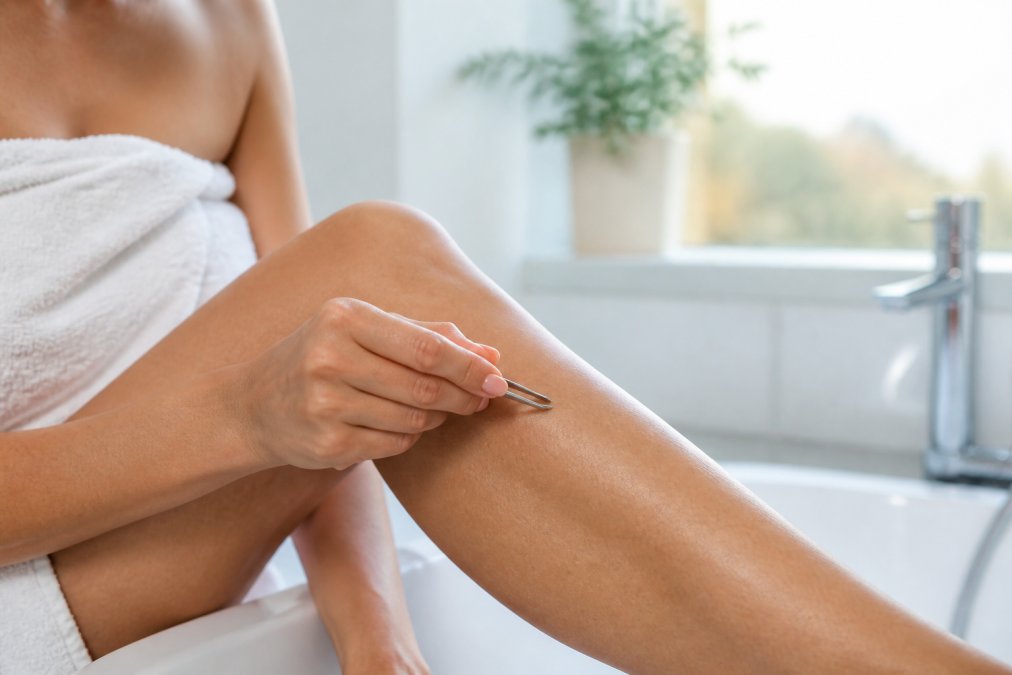
Step 3: Release the hair with a sterile needle or tweezers
This is the most delicate part of the process. Disinfect a thin needle or tweezers with alcohol. Use the needle to gently lift the loop of the hair that is visible under the skin. Do not cut or tear the skin to reach the hair if it is deep. With the tweezers, pull out only the part of the hair that is already above the surface without pulling it forcefully. The goal is to free the hair, not pluck it out, as doing so increases the risk of the hair becoming ingrown again.
Step 4: Disinfect and soothe the skin
After releasing the hair, clean the area with an alcohol-free antiseptic solution to prevent infection. Alcohol can further dry out and irritate the skin. Apply a thin layer of a soothing cream with allantoin or panthenol, which support epidermal regeneration and reduce redness. Bellaskin offers products containing exactly these ingredients, designed to soothe irritated skin and strengthen its natural protective barrier.
Step 5: Hydrate to protect the skin
Well-hydrated skin is more elastic and allows hairs to grow in the correct direction without curling inward. Apply a light-textured body lotion daily, especially to areas you regularly remove hair from. Ingredients like niacinamide and hydrating complexes keep the skin barrier healthy and reduce keratinization, which is among the primary causes of clogged follicles.
Treating an inflamed ingrown hair: when to take action yourself
When an ingrown hair is already inflamed, red, and painful to the touch, home intervention becomes riskier. Mild inflammation can be managed with an antiseptic solution and a cold compress to reduce swelling. In this case, do not attempt to release the hair until the skin has calmed down, as doing so could spread bacteria deeper into the follicle.
If you notice a pus-filled pimple that does not pop on its own after a few days, or if the area becomes increasingly warm and painful, it is likely an infected ingrown hair. Here, home methods alone are not enough.
When inflammation becomes folliculitis: the clear line
In dermatology, there is an important distinction between a simple ingrown hair and folliculitis—an infection of the hair follicle caused most commonly by bacteria such as Staphylococcus aureus (the CDC). This distinction determines whether you can manage the condition yourself or if an antibiotic is necessary.
Signs that inflammation has turned into an infection:
- The appearance of yellowish or greenish pus gathering under the skin and forming a visible head
- Redness spreading more than 1-2 centimeters around the follicle
- A sensation of warmth in the affected area that does not subside with a cold compress
- Pain that intensifies when touched or even while at rest
- Body temperature or chills—in this case, seek medical attention urgently
If you notice at least two of these signs, home treatment is no longer appropriate. An infected follicle requires a topical antibiotic prescribed by a dermatologist after an examination. In milder cases, the doctor may prescribe a mupirocin or clindamycin cream, and for more severe or recurring infections, an oral antibiotic (PubMed). Self-treating with over-the-counter antibiotic ointments carries the risk of resistance and masking symptoms.
What a dermatologist does for an infected ingrown hair
During the examination, the dermatologist first evaluates whether the infection is superficial or has reached deeper layers of the skin. In most cases, they make a small incision with a sterile scalpel to drain the pus and release the hair. This procedure takes minutes and brings immediate relief. Afterward, the appropriate antibiotic—topical or systemic—is prescribed depending on the severity.
Recurrent folliculitis: when the problem doesn't go away
If infected ingrown hairs appear regularly in the same spots, it may be a sign of a deeper problem. Chronic folliculitis is often linked to bacterial colonization of the nasal mucosa, from which bacteria constantly move onto the skin. In these cases, a dermatologist may recommend a benzoyl peroxide cleansing gel for daily use on the affected areas, as well as antibacterial therapy aimed at breaking the re-infection cycle.
People with diabetes or immune deficiencies are at higher risk of complications from folliculitis. If you have a chronic condition and notice an infected ingrown hair, do not wait for the symptoms to worsen; consult a doctor at the first signs of pus-filled inflammation.
Skin care after hair removal: preventing new ingrown hairs
Prevention begins even before the hair removal itself. Exfoliate the skin the day before the procedure to remove dead cells, but not immediately afterward, when the skin is most sensitive. Shaving should always be done in the direction of hair growth using a sharp, clean razor. The fewer passes you make over the same area, the lower the risk of irritation.
Regular care between procedures is just as important. This is where supportive cosmetics come in. Products with niacinamide and allantoin, like those in the Bellaskin range, soothe redness and strengthen the skin barrier. If you prefer more permanent solutions, IPL hair removal reduces hair density over time, which significantly lowers the frequency of ingrown hairs.
Individualized approach: care based on skin type
Most advice for preventing ingrown hairs treats skin as a uniform surface. In reality, your skin type determines which exfoliants are safe, how often to use them, and what type of hydration is necessary. A poorly chosen product can worsen the problem exactly where you are trying to solve it.
Dry and sensitive skin:
Dry skin has a compromised barrier and flaky patches that block hair. Mechanical exfoliants with apricot kernel or sugar granules are too aggressive; they create micro-tears and intensify inflammation. Instead, use a chemical exfoliant with lactic acid in a 5-7% concentration, which simultaneously dissolves dead cells and retains moisture. Apply it once a week, not daily. After hair removal, apply a thick cream with ceramides and squalane, which restore the lipid barrier.
Oily and acne-prone skin:
Oily skin produces more sebum, which mixes with dead cells and clogs follicles more easily. Here, salicylic acid (BHA) is the gold standard; it is oil-soluble and penetrates the pores to clean them from the inside. Use a lotion or toner with 2% salicylic acid two to three times a week on the areas you remove hair from. Avoid heavy oils and rich creams that further clog pores. A light gel with niacinamide and zinc will regulate sebum without weighing down the skin.
Normal and combination skin:
For normal skin, you can alternate between mechanical and chemical exfoliants, but be careful with areas with thinner epidermis, such as the inner thighs. Exfoliate twice a week with a mild scrub with fine grains or an enzyme exfoliant with papain. Hydration should be light but regular; a lotion with urea in a concentration of up to 5% maintains softness without leaving a greasy film.
Seasonal routine adjustments
During the summer, when skin is more exposed to the sun and sweat, the risk of clogged follicles increases. Sweat mixed with dead cells and sunscreen creates a sticky layer that blocks the hair. During the warmer months, increase the frequency of chemical exfoliation by one additional day per week and use a non-comedogenic sunscreen gel rather than a thick cream. In winter, when heating dries out the skin, opt for richer hydrating formulas and reduce exfoliation to avoid contributing to further dryness.
| Skin Type | Suitable Exfoliant | Frequency | Post-Hair Removal Hydration |
|---|---|---|---|
| Dry and sensitive | Lactic acid 5-7% | Once a week | Cream with ceramides and squalane |
| Oily and acne-prone | Salicylic acid 2% | 2-3 times a week | Light niacinamide gel |
| Normal and combination | Enzymatic or mild mechanical | 2 times a week | Lotion with up to 5% urea |
How to safely test a new product
Before incorporating a new exfoliant into your routine, test it on a small area on the inside of your arm for 24-48 hours. If redness, burning, or itching occurs, the product is not suitable for your skin. When introducing a chemical exfoliant, start once a week and gradually increase the frequency to give your skin barrier time to adapt. Combining several new products at once makes it difficult to identify the culprit in the event of an adverse reaction.
Common mistakes that worsen the problem
The biggest mistake is squeezing an ingrown hair like a pimple. This pushes the hair deeper into the dermis and almost guarantees an infection and a scar. The second common mistake is shaving on dry skin or with a dull blade, which leaves rough hair edges and increases the chance of the hair getting stuck as it grows back.
Many people also neglect hydration, thinking it has nothing to do with ingrown hairs. In fact, dry, flaky skin creates an uneven surface that makes it difficult for the hair to push through. Finally, wearing tight clothing immediately after hair removal rubs the skin and can reverse the direction of newly grown hairs, especially in the bikini area.
Conclusion: How to keep your skin smooth without ingrown hairs
Dealing with ingrown hairs requires patience and consistency, not aggressive methods. Regular exfoliation, proper shaving technique, and daily hydration are the foundation of healthy skin without ingrown hairs. When an ingrown hair does appear, follow the five steps we described, and do not hesitate to consult a dermatologist at the first signs of infection.
At Bellaskin, we believe that good skincare begins with the right ingredients. Our formulas with niacinamide, allantoin, and Korean plant extracts are designed to soothe redness, brighten dark spots and scars, and strengthen the skin's natural defenses. With clinically proven effectiveness and over 4,000 satisfied customers, we are here to help you achieve smooth and radiant skin.
Ingrown hairs are an annoying but completely manageable problem when approached correctly. Combine a good daily routine with quality products that support the skin barrier, and the results will not be long in coming. Start with Bellaskin.
Frequently asked questions
Can an ingrown hair be squeezed like a pimple?
Do not squeeze an ingrown hair. This increases the risk of infection, deepens the inflammation, and can leave a permanent scar. Instead, soften the skin with a warm compress for 10-15 minutes, then try to release the hair using a sterile needle or tweezers. If the hair is deep under the skin or there is pus, do not touch it and consult a dermatologist.
What is the difference between a pimple and an ingrown hair?
A pimple is the result of a clogged pore with dead skin cells and sebum, often caused by bacteria. An ingrown hair occurs when the hair grows sideways under the skin or cannot break through the epidermis. With an ingrown hair, you can often see a dark spot or the curved part of the hair under the surface. A pimple usually has a white or yellow head, while an ingrown hair causes localized redness around the follicle itself.
How long does it take for an area with an ingrown hair to heal?
With proper care, a mild ingrown hair heals in 2 to 7 days. If there is inflammation, the process can take up to 2 weeks. Regular exfoliation and hydration accelerate skin regeneration. If the redness does not subside after a few days or pus appears, seek a dermatologist to treat the inflamed ingrown hair.
What are the best methods for preventing ingrown hairs?
The best prevention includes regular exfoliation 2-3 times a week to remove dead skin cells. Shave in the direction of hair growth with a sharp blade and use a moisturizing shaving cream. After hair removal, apply a body lotion with soothing ingredients like allantoin to maintain the skin barrier. Avoid tight clothing immediately after hair removal to reduce mechanical irritation.