


Table of Contents
- What are the most effective ingredients for radiant skin
- Niacinamide benefits for the face: From science to results
- Korean cosmetics for radiant skin: Why it works
- Soothing facial redness: An approach for sensitive skin
- How to use a niacinamide serum: A protocol for maximum effect
- Difference between concentrations: 5% vs 10%+ niacinamide
- Conclusion: Your path to radiant skin
- Frequently asked questions
Last updated: September 27, 2026
What are the most effective ingredients for radiant skin
Radiant skin is the result of a combination of properly selected active ingredients and consistent care, rather than a single product. At the heart of this effect are several proven components that work simultaneously on hydration, tone, and the protective barrier. This guide from Bellaskin examines the most effective ingredients for radiant skin and shows you how to use them correctly without irritating sensitive skin.
According to a review of niacinamide in dermatology, niacinamide is among the most studied active ingredients for topical use. It acts on sebum secretion, pigmentation, and the skin barrier simultaneously, making it a rare "multifunctional ingredient" in a single formula.
If you are looking for ingredients that provide visible results without overloading the epidermis, here are those that deserve a place in your routine:
- Niacinamide (Vitamin B3) for tone, pores, and barrier
- Allantoin for soothing and regeneration
- Antioxidants for protection against photo-damage
- Hydrators for retaining water in the epidermis
Niacinamide (Vitamin B3): The multifunctional star
Niacinamide is a water-soluble form of Vitamin B3 and acts as a precursor to NAD+, a coenzyme involved in cell regeneration. In practice, this means a more even tone, tighter pores, and less visible redness.
What most guides overlook: niacinamide does not act as an exfoliant. It does not "peel" the skin but regulates processes beneath the surface. That is why it is also suitable for sensitive skin that does not tolerate acids.
Allantoin: The soothing power of nature
Allantoin is an ingredient with a proven soothing and keratolytic effect. It softens flakiness, reduces discomfort, and supports the regeneration of the epidermis. Combining it with niacinamide is logical: one regulates, the other soothes.
In our formulas, allantoin works together with Korean plant extracts to reduce the risk of irritation during active care.
Niacinamide benefits for the face: From science to results
Niacinamide benefits for the face boil down to three main effects: brightening hyperpigmentation, regulating sebum secretion, and restoring the protective film. These effects are interconnected because skin with a compromised barrier reacts with inflammation and produces more sebum.
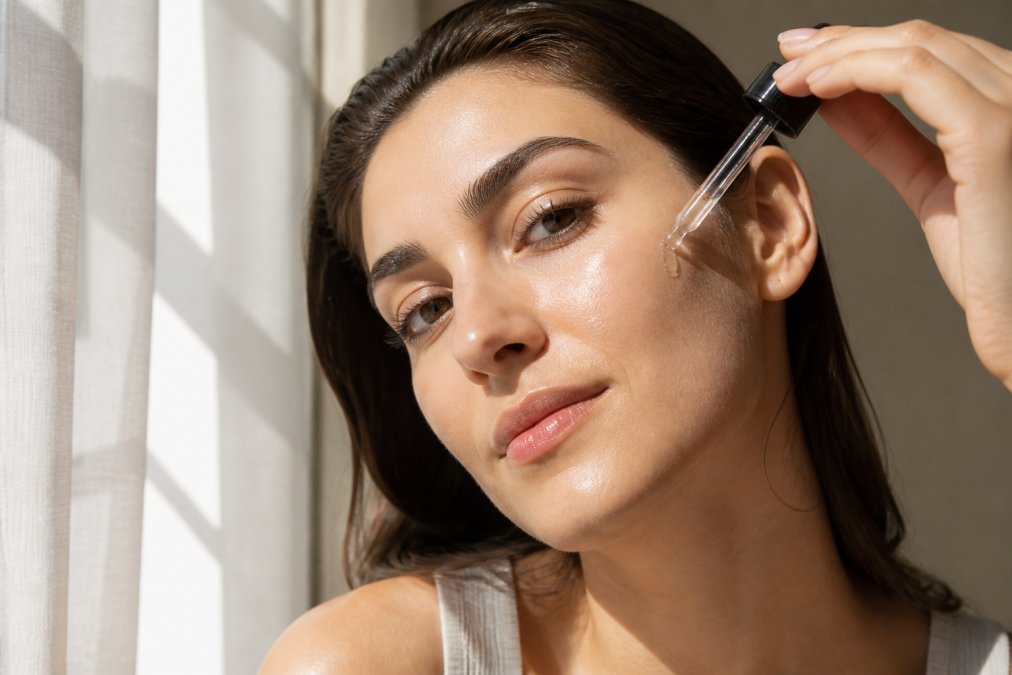
Hyperpigmentation and dark spots
Niacinamide blocks the transfer of melanin granules from melanocytes to keratinocytes (pubmed.ncbi.nlm.nih.gov). This does not remove existing pigment but stops the appearance of new spots. Therefore, the result comes gradually, usually after a few weeks of consistent use.
Post-acne dark spots are among the most common complaints, and niacinamide is one of the few active components that acts on both pigmentation and inflammation simultaneously.
Pore tightening and sebum secretion
Regulating sebum does not mean drying out the skin. Niacinamide reduces overproduction without stripping the skin of its natural oils. The result is a more matte complexion and visibly tighter pores.
Korean cosmetics for radiant skin: Why it works
Korean cosmetics for radiant skin work because they approach care as a multi-layered system rather than a single product. Instead of one potent active, the formulas combine several ingredients in low but stable concentrations.
The "glass skin" philosophy is not marketing. It describes skin whose barrier is in good condition, hydration is optimal, and tone is even. To achieve this, Korean formulas rely on:
- plant extracts with anti-inflammatory action
- allantoin and panthenol for a soothing effect
- niacinamide in concentrations between 2% and 5%
- light textures that do not clog pores
If you already have a routine with Korean cosmetics, you don't need to change it entirely. It is enough to add one niacinamide product and wait a few weeks before judging the results.
Soothing facial redness: An approach for sensitive skin
Soothing facial redness begins with reducing aggression in your routine, not by adding more active ingredients. Sensitive skin reacts to excessive exfoliation, alcohol, strong fragrances, and even too frequent changes in products. When the barrier is compromised, even familiar ingredients can cause burning and redness.
Anti-inflammatory action and protective barrier
Redness is often a signal of inflammation and a damaged barrier. Transepidermal water loss increases, the skin becomes more reactive, and any new product can trigger a reaction. At this point, adding more active ingredients worsens the condition instead of improving it.
Allantoin and calendula extract have an anti-inflammatory effect and support the restoration of the protective film. When the barrier is restored, redness visibly decreases. Panthenol (provitamin B5) also retains water in the epidermis and reduces discomfort. Niacinamide in a low concentration (2-5%) supports the synthesis of ceramides, the lipids that build the barrier.
Peel Shot White Rice Peeling Ampoule →
How to recognize a damaged barrier
Symptoms that indicate the barrier is compromised include:
- redness and a feeling of burning even with neutral products
- tightness and dryness immediately after washing
- flakiness on the cheeks and around the nose
- increased sensitivity to previously familiar ingredients
If you recognize three or more of these symptoms, stop active care for 7-10 days and switch to a minimal routine: a gentle sulfate-free cleanser, a moisturizing cream with ceramides, and sunscreen. Only after the redness decreases should you introduce active ingredients one by one.
Ingredients that soothe and those that irritate
| Soothing ingredients | Irritating ingredients for sensitive skin |
|---|---|
| Allantoin | High percentage of alcohol (Alcohol Denat.) |
| Panthenol (provitamin B5) | Synthetic fragrances |
| Calendula extract | Essential oils in concentration |
| Niacinamide 2-5% | AHA/BHA acids with daily use |
| Ceramides | Retinoids without gradual introduction |
The combination of allantoin and panthenol is particularly suitable for sensitive skin because it acts on two different levels: allantoin reduces inflammation, while panthenol retains water and supports regeneration. Together, they create an environment where niacinamide can work without causing a reaction.
How to use a niacinamide serum: A protocol for maximum effect
How to use a niacinamide serum correctly: apply it to cleansed skin before heavier creams, once a day at the beginning. Here is the full protocol:
- Cleanse your face with a gentle sulfate-free product
- Wait 1-2 minutes until the skin is completely dry
- Apply 2-3 drops of niacinamide serum to your face and neck
- Wait 1 minute for absorption
- Apply a moisturizer to lock in the ingredients
- Always add sunscreen in the morning
Patch test: A mandatory step for sensitive skin
Before applying a new product to your entire face, do a patch test. Apply a small amount to the inside of your forearm or behind your ear and wait 24 hours. If there is no redness, itching, or burning, the product is well-tolerated by you.
This step takes one day but saves weeks of recovery.
pH balance and combining with other active ingredients
Niacinamide is stable at a pH between 5 and 7, which makes it compatible with most formulas. The problem arises with simultaneous use with pure ascorbic acid, which requires a low pH. If you insist on both, use them in different steps of your routine.
| Active ingredient | Combination with niacinamide | When to use |
|---|---|---|
| Hyaluronic acid | Excellent | Any step |
| Allantoin | Excellent | Any step |
| Retinoid | Good with introduction | Evening, sequentially |
| Ascorbic acid | Caution | Separated steps |
| AHA/BHA acids | Caution | Alternating days |
Difference between concentrations: 5% vs 10%+ niacinamide
A higher concentration does not mean a better result. With niacinamide, the rule is counter-intuitive: the main benefits are achieved between 2% and 5%, while above 10%, the risk of redness and burning increases significantly.
For sensitive skin, 5% is the optimal starting point. If your skin is tolerant and you have pronounced hyperpigmentation, you can move to a higher concentration after a few weeks.
Bellaskin offers formulas with niacinamide and allantoin in concentrations tailored for sensitive skin. The Collagen Jelly provides deep hydration and a porcelain skin effect, while the Peel Shot White Rice Peeling Ampoule removes blackheads and unclogs pores without redness.

Conclusion: Your path to radiant skin
Radiant skin does not come from a single product, but from consistency and correctly combined ingredients. Niacinamide and allantoin are among the few active components that work simultaneously on tone, pores, and the skin barrier without overloading the epidermis.
If you are looking for a ready-made solution, Bellaskin's formulas combine niacinamide, allantoin, and Korean plant extracts in textures suitable for sensitive skin as well. Learn more about the principles of Korean skincare and build a routine that works long-term.
If your routine is not delivering visible changes, the problem is rarely a lack of products, but a lack of properly combined ingredients. Bellaskin creates formulas with niacinamide and allantoin that soothe redness, strengthen the skin barrier, and provide antioxidant protection. Explore the collagen jelly and the Peel Shot White Rice Peeling Ampoule to start with care tailored to sensitive skin. Buy now and see the results.
Frequently Asked Questions
What are the most effective ingredients for radiant skin?
Niacinamide (vitamin B3) and allantoin are among the best-studied. Niacinamide evens out tone, regulates sebum production, and strengthens the skin barrier. Allantoin soothes redness and aids regeneration. The combination of the two provides visible results for radiant skin without irritating sensitive skin.
How does niacinamide help even out skin tone?
Niacinamide blocks the transfer of melanin from melanocytes to keratinocytes, which reduces the appearance of dark spots and hyperpigmentation. It also reduces the inflammation that underlies uneven tone. With regular use for 4-8 weeks, a more even tone and reduced redness can be noticed.
How do I test if an ingredient irritates my skin?
Perform a patch test: apply a small amount of the product to the inside of your forearm or behind the ear. Wait 24-48 hours. If there is no redness, itching, or burning, the product is safe for your face. For sensitive skin, start by applying it every other day until your skin gets used to it.
Can one product handle both ingrown hairs and dark spots?
Yes, if the formula contains niacinamide and allantoin. Niacinamide lightens dark spots and regulates sebum. Allantoin soothes inflammation around the follicles. Products like collagen jelly with Korean extracts can address both problems simultaneously.